Wayne Gretzky was holding his hallway scrum on the night of Oct. 6, 2007, after his Phoenix Coyotes lost a 3-1 game to the Boston Bruins, the second game of the season for both teams.
Far away from hockey’s epicenter out in Glendale, Arizona, Phoenix’s version of Foxboro, the Great One surveyed the faces of sportswriters popping postgame questions when he was quoted to have said something like, “I don’t think you realize how good this guy is.”
Except maybe for Daniel Dore, the Bruins’ amateur scout focusing on the Province of Quebec, none of us did.
Patrice Bergeron wasn’t the kind of hockey player that jumps over the boards and wows fans at the sight of his stride, his stickhandling or his shot. Against the Coyotes, Bergeron scored a powerplay goal and went minus-1 on a night most of the questions were about other players.
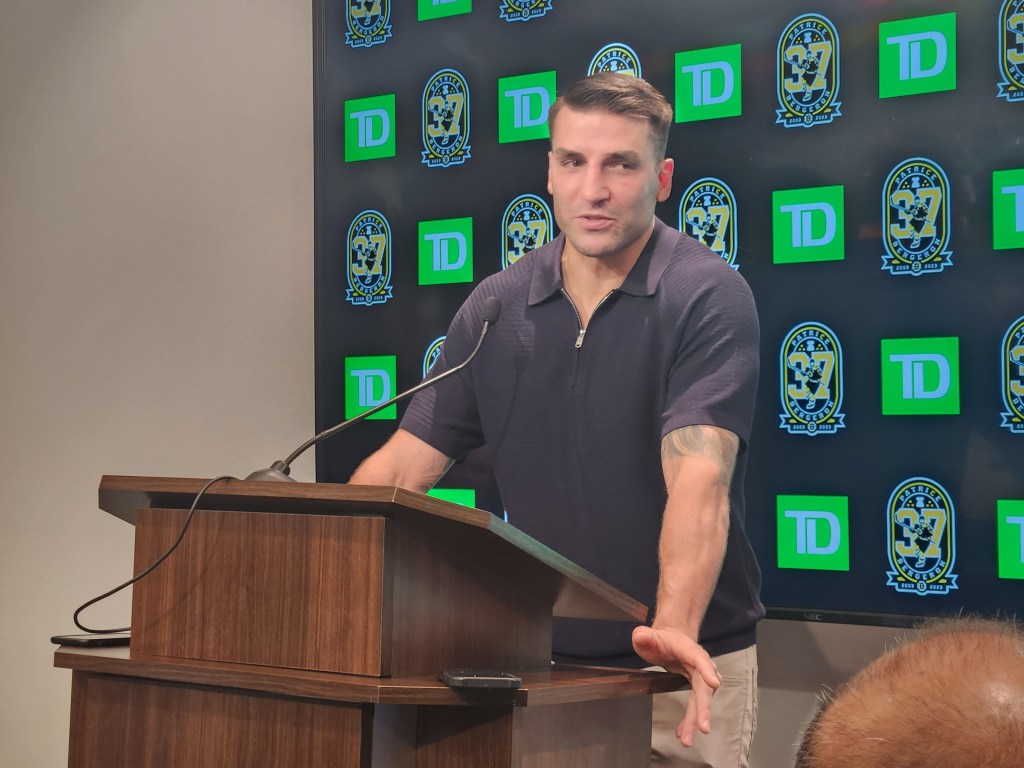
Patrice Bergeron will take his place this fall among the greats of Boston sports when his No. 37 is retired and he is inducted into the Hockey Hall of Fame.
But it takes one to know one, and Gretzky saw instincts in Bergeron’s game, a connection with what was happening on the ice that contradicted his 22 years of age. Once in a while, hockey gets a player with an unusually mature acumen for the sport, like a coach on the ice, always in the right place, always making the smart play.
A month shy of his 41st birthday, Bergeron looks refreshed and healthy, separated now by three years from two decades of brutal battles on the ice. He’s embraced his retirement, the time he now devotes to his wife and children, firmly anchored in the Boston area – at least for now.
“I grew up a Quebec Nordiques fan, and Peter Forsberg and Joe Sakic were my role model. Now to know they’re a part of (my story) is very surreal,” said Bergeron, whose was hit with the double-whammy over the past few days, learning that his No. 37 will be raised to the TD Garden rafters (date to be announced) and that he will be inducted this fall into the Hockey Hall of Fame.
“I always wanted to be a Bruin for the length of my career. I was just really lucky that that’s something they wanted as well as an organization,” he said in Tuesday’s meeting with the media at Warrior Arena. “We also built something as a family, too. I came in as an 18-year-old, young adult, pretty clueless and built a family here – my kids were born here – so I feel like I’m part of the community now.”
With Sakic and Forsberg as role models, it’s no wonder Bergeron, together with David Krejci, provided the Bruins with a similarly elite 40 minutes of down-the-middle hockey, an enviable foundation for Stanley Cup contention that lasted over a decade.
Bergeron’s beginnings as a pro were humble, and for several years he was widely thought to be no more than a solid, third-line center, strong on the penalty kill and able to match up in a shutdown role.
His record six Frank Selke trophies as the NHL’s best defensive forward notwithstanding, we should have realized there was more coming from this chameleon of the player who, later in his career, added a one-timer not because he aspired to score 50 goals but because his team’s powerplay needed someone to hammer the puck from the left faceoff circle.
Bergeron surprised at his first professional camp, making the NHL roster as an 18-year-old. Coach Mike Sullivan slotted him in at right wing, from whence Bergeron scored in overtime to win Game 2 of the series the Bruins would lead 3-1, only to lose it in seven. Julien was Montreal’s coach.
When the NHL went on lockout for the entire 2004-05 season, Bergeron was among the young players allowed by the league to sign one-year AHL contracts, and thusly he played his first professional season as a centerman at age 19. The Providence Bruins were very good, not quite as stacked as the Philadelphia Phantoms, who took their semifinal series in six bloody games and went on to win the Calder Cup with relative ease.
When the Bruins reconvened, Bergeron was back at right wing but not for long. Amidst an early-season malaise, captain Joe Thornton was traded, and Sullivan moved Bergeron to center between his AHL right winger Brad Boyes and newcomer Marco Sturm, one of the three pieces coming back from San Jose in the blockbuster.
Bergeron’s pivot to his natural position was a silver lining around the dark cloud of a chaotic comeback campaign that resulted in the first official firing at the executive level in franchise history. General Manager Mike O’Connell out, team president Harry Sinden reduced to a consultant role to club owner Jeremy Jacobs.
Making his rookie mistakes remotely while fulfilling the obligations of his contract to the Ottawa Senators, new GM Peter Chiarelli brought in former Red Wings assistant Dave Lewis to replace Sullivan, and his 2006-07 strategy of spreading Bergeron, Boyes and Sturm across the rink with the intention of exploiting the offensive opportunities meant to come with the two-line pass, submarined the line’s tight-knit chemistry. Bergeron finished with the only minus (-28) season of his career, tied for the third-worst in the NHL that year.
When Chiarelli hired Julien, the Bruins became a puck-possession team, focusing on positioning, being strong on the puck, strong on their sticks, and reliant on sturdy, two-way play.
This, of course, was right up Bergeron’s alley.
There was no traditional pressure to jump over the boards and impress, no hairy eyeballs watching to see what individual players were going to do to gain notice. Hockey with Claude was a manageable endeavor, a game that had foundational strengths in a captain (Zdeno Chara) who was no longer trying to do too much and a future captain (Bergeron) who would epitomize the new team concept.
“I think the biggest thing for me was I never felt satisfied from one year to the next. I always wanted to raise the bar and get better,” said Bergeron, referencing early-career influences like Martin Lapointe and, later, Zdeno Chara and Mark Recchi. “I felt like there was always something to learn from teammates, from opponents, from obviously coaches and trainers, and that was always what drove me to keep improving and push me, challenge me … I think that builds some consistency because of that.”
Bergeron’s first challenge in hockey was embracing Canada’s winter pastime. When visiting family in his native Quebec City, he still hears about his first year in skates, sitting inside the net for a whole winter of practices.
“That’s my dad’s first quote usually when he sees how far I’ve come in a way … I guess you can never lose hope as a parent – at some point he’s going to get up,” said Bergeron, recalling his complaints to his parents. “I remember my skates were killing my feet … that’s why I was just sitting there. I live that right now with my youngest, and I get it. And, at some point, once I started picking it up and skating, I realized it’s a lot more fun than just sitting in the back of the net.”
Maybe that’s where Bergeron got his indelible view of the game, the same one the goaltender gets but without the ability to influence what happens out there in between shots and saves.
It was only a matter of days after Gretzky identified Bergeron as a special player that his budding career was suddenly in jeopardy. Arriving first to a puck dumped left of the Philadelphia net, Bergeron was slammed from behind, face first into the dasher by Flyers defenseman Randy Jones. The resultant concussion ended what should have been a breakout season. Instead, several weeks went by before it became apparent Bergeron would quietly begin his comeback trail. On the day of Game 7 of the Bruins’ first playoff series in four years, Bergeron worked out on Bell Centre ice with backup goaltender Manny Fernandez and a coach.
The Bruins held him out. Bergeron worked so hard in the summer of 2008 that the NHLers skating with him said they had to pull him off the rink. He probably worked too hard, because his 2008-09 comeback season looked lethargic for stretches until a collision with a puck-carrying Dennis Seidenberg (then of the Carolina Hurricanes) resulted in a second, less-severe concussion that held Bergeron out of the lineup 16 straight games at midseason. Ironically, there was pep in his step when he returned, and Bergeron was back.
“I was given that opportunity at a young age, and in a way you just run with it, you don’t really think twice. And once it’s taken away from you for a full year, you realize how much you miss it, the impact that it has on your life and how much you want it,” he recalled. “I think at that point it was a great reminder, a great life lesson that I needed to be appreciative of the good but also the bad, appreciative of the darker days or the tougher times.
“You know, when it’s dark out at 4 pm in February, you think life isn’t great and to realize how special to be in this position that a lot of people would do a lot of things to be in my shoes and to have this opportunity, so seize it and enjoy it … every day no matter what the challenge is, so I think that really put a lot of perspective on the rest of my career.”
After posting 116 points in 2008-09 and losing a Game 7 overtime in the second round to Carolina, the Bruins struggled offensively through the 2009-10 season. One of the arduous winter’s few highlights was Bergeron’s playmaking heroics that saved the day in the 2010 Winter Classic at Fenway Park. Sturm, who scored the game winner in overtime that day, was in attendance Tuesday as Bergeron greeted the Boston media at Warrior Arena to celebrate his dual accomplishments.
“It’s been overwhelming in a way,” said Bergeron. “A lot of people have reached out, a lot of former teammates, which is always great to hear from, friends from back home, family members, former trainers from the summer time. … It’s been a crazy few days to say the least, but I’m very grateful.”
Nothing came easily for Bergeron, but he never considered the process of earning trust to be a hardship. For him, earning opportunity was not a birthright but part of the competition and the learning process that accompanies it.
Even his triple-gold achievement with Team Canada in the World Championships, the World Junior Championships (in that order!), and the Olympics was a prove-it process. His selection to the 2010 Canadian Olympic team raised the eyebrows of his own country’s media establishment, their mock line charts placing him outside the 12 forwards that would actually suit up and play. There was widespread surprise when he was in the lineup, but soon the more-astute hockey minds in Canada’s media were marveling at Bergeron’s reliability on the ice.
Sometimes, greatness is hiding in plain sight, and even the experts need time to identify a special athlete.
Today, Bergeron is a role model for hockey players well into their careers. Not all his children realize what the fuss is all about. He even joked that his youngest likes No. 37 because his big brother wears it.
For those of us still around who are fortunate enough to have followed the careers of franchise icons, be it Johnny Bucyk, Bobby Orr, Phil Esposito, Wayne Cashman, Terry O’Reilly, Rick Middleton, Raymond Bourque or Cam Neely, each brought his own brand of beauty to the game. Each had his own set of skills, his own mind, sense of creativity and ferocity in the competition. Each had his own way of bringing us to our feet.
Bergeron had his highlights to be sure – cue Dave Goucher’s Game 7 call from 2013 – but the way he’ll be remembered by Rink Rap is more in the everyday, ground-floor process, the manner in which he conceptualized hockey as a team game, every on-ice decision made with the team in mind.
As my esteemed colleague Mark Divver posted on X how hundreds of young players have told him over the years that Bergeron is their role model, rare is the player who not only acknowledges the importance of competing hard on both sides of the puck but is actually hardwired to organically conceptualize hockey from a team standpoint.
Can Fraser Minten provide a sequel story to Bergeron’s as Bourque followed in the wake of Orr, or in tennis the way Carlos Alcaraz has countryman Rafa Nadal? Years will eventually tell, but it’s going to be fun following along and watching a player whose internal programming for hockey most resembles the all-time great whose unique contributions to the game will soon be celebrated on TD Garden ice and in Toronto at the Hall of Fame.

