The Boston Bruins became David Pastrnak’s team on March 7, 2025, the day Brad Marchand was traded to the Florida Panthers. It just took a year and a half for it to become official.
Pastrnak’s appointment as the 28th captain in franchise history comes with the feeling that – all due respect to top defenseman and A-wearing alternate Charlie McAvoy – skipping over the 30-year-old veteran of 929 games (playoffs included) right now would have been a mistake.
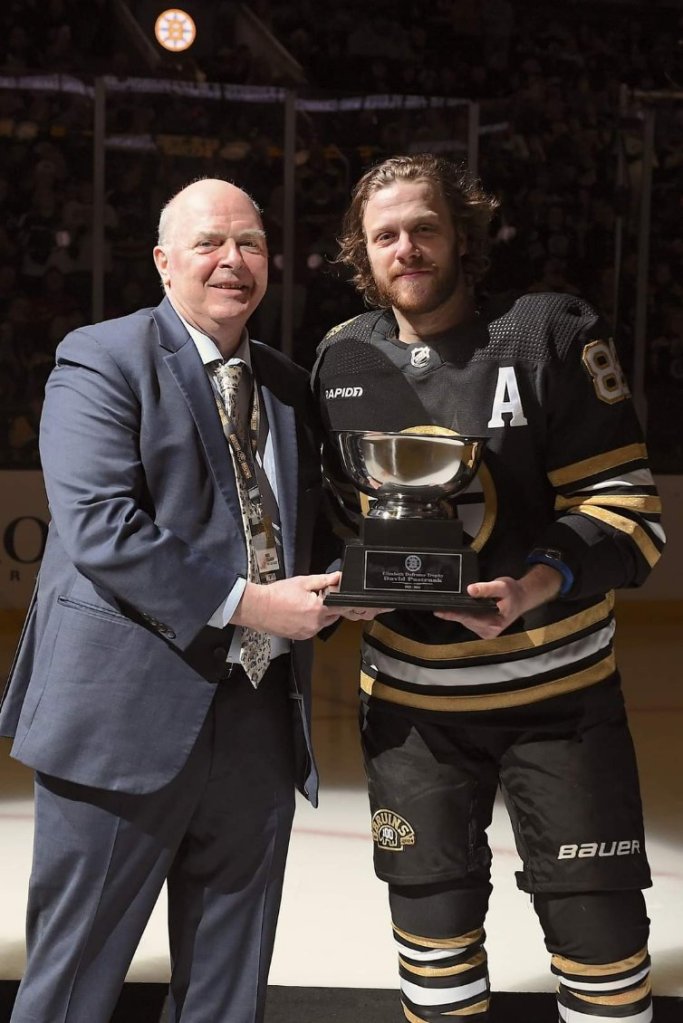
Because our Professional Hockey Writers Association chapter president Joe Haggerty had a family conflict, Haggs offered me the opportunity to present David Pastrnak with the Elizabeth C. Dufresne Trophy as the best Bruin in home games (as voted by Bruins beat writers). The centennial 2023-24 season was Pasta’s third straight time winning the award (but the hardware has not been retired). Thanks to the legendary Steve Babineau for taking this photo.
It’s not just that Pastrnak stands in the line of succession among the core Bruins of this generation in keeping with the progression of the torch having been passed along from Zdeno Chara to Patrice Bergeron and then to Marchand. And it’s not about his historic streak of four straight 100-point seasons (Bobby Orr and Phil Esposito territory).
It’s actually more anecdotal than that.
The mini-teardown that saw Marchand, Brandon Carlo, Charlie Coyle, Trent Frederic and Justin Brazeau go to other NHL teams, defining a tumultuous 2024-25 season, began on a surprisingly flat note, and the overall campaign perhaps never had a fair chance with a campless Jeremy Swayman chasing his form and Jim Montgomery’s ambitious puck-possession system (i.e. everyone touches the puck in transition) shortcircuiting amidst a team that meandered to the 8-9-3 start that got Monty fired.
Associate Head Coach Joe Sacco leaned heavily on Marchand and Pastrnak to settle the room and simplify the game by influencing better structure that seemed to have righted the ship by the calendar year’s end. Under Sacco, the Bruins were 12-5-1 before reality sank in that they needed to score four goals on most nights to win games. The defensemen pushed too hard to add offense, and winnable games became losses. As those losses began to pile up, and especially after McAvoy joined Hampus Lindholm on the sidelines with a second, crippling, season-ending injury, Pastrnak began to emerge as a constant, guiding light for the troubled team only two years removed from its magical, 135-point season of 2022-23.
When Sweeney conducted the reset and Marchand was helping the Panthers repeat as Cup champs, it was Pastrnak who answered to the media for the Bruins’ problems – most every night, win or lose – but especially when the game of hockey blew up in their collective face.
It was at this lowest point for the franchise in the 20 years that had passed since the Bruins last traded their captain (Joe Thornton) that Pastrnak’s value on and off the ice crystalized. He made no excuses, he told it like it was, he was the consummate professional and, at the same time, never lost his true nature as a good guy to talk to, for fans to meet and greet. Pasta proved he could take the worst that this game has to offer and stand tall, leading the way for the next challenge.
What more could you want?
Lest this sound like a criticism of Bruins management, let it be known that Johnny Bucyk was once stripped of the “C” from his spoked-B sweater because, upon a similar upheaval in core personnel, second-year coach Harry Sinden thought it prudent to go all A’s and let the room sort itself out. That’s how the erstwhile club president and legacy GM explained it to Rink Rap.
As assistant to Hap Emms, GM Milt Schmidt had acquired Phil Esposito in the famous 1967 blockbuster trade that sent prime defense prospect Gil Marotte, center Pit Martin and goaltender Jack Norris to the Black Hawks for Esposito, fellow centerman Fred Stanfield and right winger Ken Hodge. With Bobby Orr a year into his NHL career, Derek Sanderson ready play the shut-down role, Wayne Cashman and Don Marcotte almost ready to augment the elite Bucyk on left wing, the Bruins were on the cusp of greatness.
Then come the intangibles, so Sinden wanted to let it breathe and give the room time to organically produce leadership. Bucyk, Esposito, Ted Green and Ed Westfall would all wear the A through the halcyon years of the Big, Bad Bruins (1967-68 through 1971-72). Four A’s were allowed in that era. Check the photos of Bucyk carrying the Cup on May 10, 1970, in Boston Garden and May 11, 1972, in Madison Square Garden. He’s wearing an A, not a C.
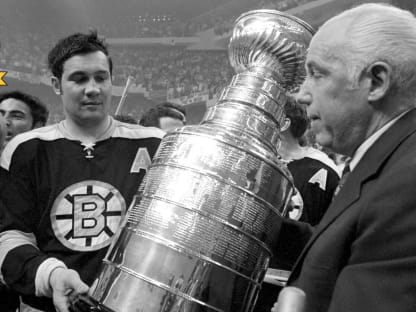
Johnny Bucyk receives the Cup from NHL president Clarence Campbell on May 10, 1970, at Boston Garden after Bobby Orr’s famous overtime goal beat the Blues.
Bucyk didn’t get back the C he had worn in 1966-67, the final year of the six-team NHL and Bobby Orr’s rookie campaign, until 1973-74, after signing an extension to complete his career as a Bruin during an era when core players were leaving their NHL teams to chase the millions promised by the rival World Hockey Association. Bucyk stayed, and with Green (WHA Whalers) and Westfall (NHL expansion N.Y. Islanders) out of the room, Bucyk had a choice. He stuck around, and Sinden stuck the C back on his sweater.
Prior to 2025-26, the only other full season in modern NHL history that the Bruins went without an official captain was in 2001-02, after Jason Allison was traded amidst an offseason contract dispute. Those Bruins finished first in the Eastern Conference and second overall to eventual Cup champion Detroit, but former GM Mike O’Connell’s two best squads (2003-04 as well) tend to get swept under the rug of miserable times in the early days of the new Garden because they couldn’t get past Montreal in the playoffs.
From sewing to whittling: The Boston Bruins announced today the following roster transactions: Jake Schmaltz will report to Providence Bruins Training Camp. Riley Duran and Dans Locmelis have been assigned to Providence. Henri Jokiharju has been placed on waivers for the purpose of assignment to Providence. Matt Poitras (Date of Injury: Sept. 22) has been placed on injured reserve.
Not counting Matt Poitras, this gets the Bruins down to 13 forwards and 8 defensemen and, with Swayman slated to lead a tandem with Michael DiPietro, puts the Bruins at the 23-man roster limit. The Poitras injury kicks the can down the road, probably through a rehab assignment in Providence. Based on what reporters have posted from Sunday morning practice at Warrior, the forward lines and defense pairings are as follows as the Bruins get ready for the Rangers on Tuesday night at TDG (8 pm, ESPN, 98.5).
10 Peterka – 28 Lindholm – 88 Pastrnak
11 Mittelstadt – 18 Zacha – 39 Geekie
44 Hagens – 93 Minten – 92 Khusnutdinov
72 Jeannot – 52 Kuraly – 47 Kastelic
scratch: 81 Eyssimont
27 Lindholm – 17 Borgen
91 Zadorov – 75 Clifton
42 Brunet – 6 Lohrei
scratch: 45 Aspirot
[suspended: 73 McAvoy]
1 Swayman
30 DiPietro
A couple of comments as the Bruins have managed to whittle the roster down a NHL-ready 23: Jonathan Aspirot has not looked great in this camp, but it’s possible that Mason Lohrei’s apparent start as the left shot playing right D on the third pairing with rookie Frederic Brunet is a showcase move. I cannot imagine that the Bruins are up for another year of kicking the Lohrei can down the road. The progress on the defensive side of the puck simply hasn’t justified continued patience. Lohrei is an impressive talent and may someday get his overall game into a winning kind of shape, but a good case study for this kind of defenseman is Shayne Gostisbehere, whose rights ping-ponged around the league before he broke in with the Flyers. He has switched teams four times in the past five years, resettling with the Carolina Hurricanes in a sheltered role over the past two seasons and made meaningful contributions to their 2026 run to the Stanley Cup. Can Lohrei improve similarly and find his niche? Perhaps, many talented athletes have seen their professional sports careers meander and finally fizzle out amidst some combination of age, injury and bad breaks. Lohrei is a good kid with upside and flaws. In a smaller NHL, he’d be playing full time in the AHL, but that’s not how the league is now with a salary cap and a need to develop players on the job. When those players are in crucial positions such as defense in hockey, it’s up to the coach to match the player up carefully against opponents and with teammates. That can become complicated when, on one hand, the player needs to grow his game in his advantageous roles and, on the other, needs support on the ice from players who excel in the parts of the game that he currently lacks. Lohrei turns 26 on Jan. 17, but the Bruins continue to look at him like he’s 21. Maybe 26 is the new 21. … Eyes will be on J-J Peterka come Tuesday night, but Will Borgen and Connor Clifton will need to be in midseason form holding down the right side with McAvoy out the first six games, especially if Lohrei (left shot) is next man up. … Morgan Geekie spent time in this shortened camp left wing opposite Pastrnak, but in the past week Coach Marco Sturm shifted him to right wing on a line with Pavel Zacha and Casey Mittelstadt. I see the overall concept: choosing between skating Peterka with Zacha and Mittelstadt, ostensibly making him the only top-six change (for Viktor Arvidsson – a sensible consideration given the short runway of training camp with the 84-game schedule) versus skating Peterka with Pastrnak and exploring his offensive upside and making the game as easy as possible for the newcomer. This, of course, places Geekie back on right wing, where he tends to struggle to find good scoring looks. Sturm encourages players to move around when his team has the puck. There is theory and there is practice. Geekie continues to show he can finish around the net and also from the left side of the ice (stick inside). That’s him. I know I’m a broken record on this. The concern here is Geekie will be hard pressed to match last season’s production on right wing. His game is prolific in certain skills and limited in others. Keep an eye on this.

