Instead of ending later, hockey is starting sooner.
In 2026, September not only promises Boston Bruins training camp but, for the first time in over three decades, the National Hockey League’s return to an 84-game regular season, something done only twice previously in league history: 1992-93 and 1993-94.
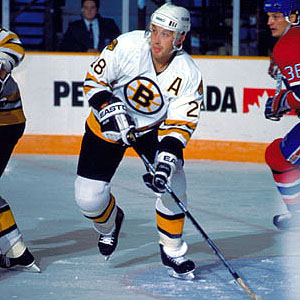
Garry Galley was among many who started the 1991-92 season with the Bruins but finished the season and his career elsewhere.
Yes, the NHL has played 84 games before.
When Rink Rap was a shorty, the six-team NHL played a 70-game season followed by two rounds of playoffs to determine the Stanley Cup champion (thus, the Red Wings fans’ tradition of tossing an octopus onto the Olympia ice, its eight arms signifying the eight wins it took to capture the Cup). When the league doubled in size with its 1967 expansion beyond the Mississippi River, the NHL went from six to 12 teams, from 70 to 74 games and from two to three rounds of playoffs including the strange, self-contained, West Division playoff that guaranteed an expansion team in the Cup final – that team was St. Louis all three years. In 1968-69, the second of those three seasons, the NHL went to 76 games (having successfully managed 74 that first year). With the addition of Buffalo and Vancouver (to the East!) upon Chicago’s 1970-71 move to the West, the NHL went to 78 games and the second round became a crossover. Except for a 1971-72 QF switch from 1v3 and 2v4 to 1v4 and 2v3, the playoff format stayed intact for four years including the expansion to Atlanta and Long Island (coincidental with the 1972-73 birth of the rival World Hockey Association). Adding Washington and Kansas City in 1974-75, the NHL went to 80 games (and four divisions) with a 12-team playoff for the rest of the decade. Division winners were awarded byes into the quarterfinals, while the next eight teams were seeded by points in a best-of-3 format to produce the other four quarterfinalists. The Bruins’ record in the preliminary round: 0-1, their 3-game, 1975 upset loss to Chicago unwittingly ending the Orr-Esposito era in Boston. When the 1975-76 season began, Orr had yet to return from offseason knee surgery. The Bruins struggled out of the gate and were a .500 team a week into November when GM Harry Sinden ended the Big, Bad Bruins as we had known them by trading Phil Esposito (and Carol Vadnais) to the Rangers for Brad Park, Jean Ratelle and Joe Zanussi (their AHL Brad Park). The trade coincided with Orr’s season debut in Vancouver, where he and Park played (and lost) the first of 10 otherwise-magical games together, manning opposite powerplay points. The shocker was how well a 36-year-old Ratelle would play in Espo’s wake, especially in 1975-76 but also for the rest of the decade. In recent years, many older Boston fans have speculated as to what might have happened for the Bruins over the second half of the ’70s had Orr more years left in his ravaged left knee. But Sinden made the deal seeing the writing on the wall. That hopeful thought gets the cart before the horse; even though Orr and Park lost only once in those 10 games, it became evident as the season went along without Bobby that the Bruins were becoming Park’s team as though Sinden realized this outcome all along.
Once the WHA ceased operations in 1979 and the NHL adopted Edmonton, New England (Hartford), Quebec (City) and Winnipeg, the 1979-80 playoff format expanded to 16 of the league’s 21 teams (everyone played a best-of-5 opening round that in 1986-87 would become best-of-7). In the ’80s, only the real bottom feeders had no postseason. It was at this time that three-sport media that didn’t like hockey to begin with began complaining that “in hockey, everybody makes the playoffs,” and they were basically right – at the time.
The NHL stuck with the 80-game schedule throughout the 1980s, dealing with in-season apathy by declaring war against the tie by introducing a 5-minute, sudden-death overtime period to the regular season in 1983-84. It did not produce the desired result. Teams were afraid to lose their hard-earned point and showed it in the OT, bringing down boos from the crowds. Thus the subsequent tweaks that would allow teams to maintain their 60-minute point, but that only turned the last 10 minutes of regulation time into a stalemate (picture two teams killing the same penalty), and boos from the crowds. Given the gravity of results, the NHL was only really able to nudge the hump on the caterpillar until the shootout was introduced with the radically different NHL that followed the 2004-05 lockout year.
In the 1991-92 season, labor strife interrupted the season with a players’ strike. The NHL settled and got the full 80 games in but, for the first time in history, decided the Cup champion in June. The result of those negotiations was two seasons of 84 games. The so-called 1994-95 season was played entirely in 1995, a truncated, 48-game schedule after an owner’s lockout intended to produce the league’s first salary cap but one that only yielded a rookie cap. When the Bruins moved into the FleetCenter for 1995-96, the NHL season was 82 games.
It’s only fair to note here that the 1990s southern expansion/migration of NHL franchises and the growth from 21 to a big-business 30-team (now 32) league in expensive, new arenas (that Rink Rap has publicly criticized as a gimmicky simulation that asks the fan for more and puts them farther away) brought about one important hockey success: a stress-filled regular season. Just the deafening silence after games on crowded freight elevators full of two teams’ hockey executives has taught me how much sleep is being lost over two points on any given night. It’s a far cry from the campier NHL in which I grew up and called home. There is only one trophy to award in June, and for six months 32 teams are trying to win it. Then 16 teams are trying to win it. Jobs get lost when owners who pay over $100 million for their roster think they should have come closer. The NBA’s recent adoption of a play-in has influenced some NHL pundits to recommend the same, but the NHL is right in its steadfast refusal to give back the competitive, pressure-packed regular season it took so many years to achieve.
Thirty-two years after two seasons of 84 games, the NHL has taken two preseason games and made them real ones. Season-ticket holders like the tweak because teams were requiring their inclusion and charging them regular-season prices, and especially in recent years some of the home-team lineups have been sparse of the names the fans that can’t afford big-game tickets want their kids to see. Players agreed because, in the era of every NHLer is a millionaire, the conditioning side of camp is covered by personal offseason training.
So this training camp will be brief, impressions will be immediate, and preseason games will be of escalated importance. The change comes at a volatile time for the Bruins, who have little runway to make decisions heading into the new season.
Before we launch into the Bruins, let’s set the scene, identify management’s stated (and/or otherwise-indicated) goals, and clarify what we’re talking about. As in: Is it our philosophy or the team’s, it is our strategy or the team’s, and is it our view of a player or the team’s?
There is nothing wrong with opinions, but things can get lost in the conversational blender of prediction and anticipation versus what we debate should happen or what we, as fans, would like to see happen. So an effort will be made here to define terms so we don’t confuse the reader as to Rink Rap as an arm-chair general manager versus our interpretation of management’s intentions.
First off, Bruins management is painfully aware that the program set forth with the March 2025 flurry of trades that sent Justin Brazeau, Brandon Carlo, Charlie Coyle, Trent Frederic and (still-the-last) captain Brad Marchand packing will take at least three years to pay off.
Three years, as in not last season (100 points and a return to the playoffs notwithstanding – more on this below), not this season, and probably not the one after. We’re one year into what history dictates will be at least a three-year process.
The competition: It’s quite possible – arguably probable, given bounce-back campaigns expected for the Florida Panthers and the Toronto Maple Leafs, two teams that missed the 2026 Stanley Cup playoffs – that the Bruins will be hard pressed to secure a top-four finish in the Atlantic Division. The B’s may need another weak year in the Metro to make the 2027 playoffs.
That said, Rink Rap is not down on the Bruins. The pathway goes with the plotline. Rarely is such a climb back to Cup contention linear. The 2025-26 season was a success, but it didn’t exactly go according to plan.
GM Don Sweeney didn’t script it up that Henri Jokiharju and Mason Lohrei would be so up and down or that Jonathan Aspirot and Andrew Peeke would punch above their weight for over half the season, helping the Bruins stay afloat defensively amidst the more-predictable ebbs and flows of offense in the post-Bergeron/Krejci era.
The two-tier goal remains to: 1. Be a tough out, play with an edge, grow the in-house brand and model it well for the developing talent that will someday impact the team’s fortunes; 2. Draft and develop a next-generation core for the forward lines.
Regarding the immediate goal, we’ve got questions and concerns, but a year ago we projected a Boston club with a properly prepared Jeremy Swayman and a healthy Charlie McAvoy and Hampus Lindholm to be a strong, bubble team in 2025-26. The Bruins proved to be a little more than that, virtually securing their playoff spot with three weeks remaining on the schedule.
I believe, based on my wide-lens interpretation of statements and actions by Bruins management, that the short-term goal remains to be a playoff team and a hard out while trying, at coaching and management levels, to improve the team from within and without.
Going into the new season, I still don’t understand why, with a salary cap in excess of $100 million, that the Bruins “pivoted” from Viktor Arvidsson to J-J Peterka. Why not both on a team challenged to score goals when the great David Pastrnak doesn’t have his normally incredible magic to set them up for Morgan Geekie or find the net himself? Perhaps more importantly, while Peterka adds youthful speed and an ability to score off the rush, the Bruins lose a net crasher with Arvidsson’s departure via free agency.
The legacy of too many playoff series in Sweeney’s era has been that, come playoff time, the opponent was the boss in front of its own net and the opponent was the boss in front of Boston’s net. Nikita Zadorov was obviously a step in the right direction for the defensive end of that equation, and while Tanner Jeannot has been an excellent addition on multiple levels, he and Mark Kastelic are invariably bottom-sixers. The Bruins need some net-front presence in their top six, and without Arvidsson they look to take the next step with less rather than more.
On defense, Will Borgen and Connor Clifton are meant to add credible right shots to augment Charlie McAvoy, and they will have to do more than augment with the latter’s season-opening, six-game, NHL suspension for chopping at Zach Benson’s arm (in retaliation for an uncalled slewfoot at high speed as the game and series was running out of seconds and McAvoy making himself vulnerable by leaning back into Benson on that chase to prevent an empty-net goal – I imagine the great Chuck Kaiton of Whalers radio fame saying all this at breakneck speed live on the air).
Where all this leaves Lohrei and Jokiharju is anyone’s guess. Assuming Aspirot plays on opening night Sept. 29 vs. NYR, it could be Frederic Brunet at 3LD – why make the kid wait? That last part is opinion, but it makes sense that something gives re: Jokiharju if not Lohrei. It makes no sense to go forward with players that have literally been replaced.
Rink Rap also has opinions on forward lines, and one is that Matt Poitras, pending his contract (the restricted free agent has yet to sign) should launch his NHL career in earnest. He did everything asked last season in the AHL and showed all-around improvement. He has graduated from the minors. It’s time. Moreover, the Bruins badly need to graduate an AHL prospect to the NHL, and they badly need a puck-distributing centerman. Time to find out if Poitras is ready to sustain his NHL career and help the Bruins win NHL games.
One other opinion: Morgan Geekie is like fellow right shot Mike Knuble, whose career blossomed in the 2002-03 season when Bruins coach Robbie Ftorek moved him to the off wing (LW). A big body like Knuble, Geekie lacks the speed to beat defensemen down the right wing and, from the right wing, lacks the backhand deke to switch the puck inside. What he can do extremely well like Knuble and fellow former Bruins right shots Steve Heinze and Michael Ryder is play off the left side of the rink. Having coached Ryder in Montreal, Claude Julien knew exactly what to do with him upon his 2008 acquisition. It is not clear if Bruins coach Marco Sturm, a left shot who played left wing in Boston with Patrice Bergeron and Brad Boyes (later Mark Recchi), sees this in Geekie. Last season, when he moved Geekie off Pastrnak’s line, he deployed the right shot on right wing, and Geekie struggled. Off wing was a thing in Russia back in the day, and it worked great for consummate cornerman Wayne Cashman. It’s not for everyone, but so far Geekie’s goal production, when it comes from outside a 10-foot area, is invariably left of center, like Knuble, Ryder and Heinze. It appears Geekie is one of those guys. Sturm has done patient work with Geekie, getting him to focus on being a better player without the puck, but his deployment of Geekie bears watching.
Two other developments: Casey Mittelstadt is entering the final year of his contract, and silence on this front indicates some combination of a hard-to-move $5.75 million AAV and the team likes him. His NHL career is on the line. Being bullish on internal competition, perhaps Sweeney would rather see that play out than act hastily in the name of adding more forechecking speed. Also entering his final year: Pavel Zacha. As successfully as it’s gone for Sweeney to identify Zacha as a frustrated prospect in New Jersey (sixth overall, 2015), to acquire him 1-for-1 in a deal for a veteran center he had signed as a free agent (Erik Haula), to make him an apprentice watching Patrice Bergeron from the bench and David Krejci on the ice for a combined 40 minutes a game – the best education possible, then take over one of those slots in the wake of their 2023 retirements, the Bruins find themselves at a crossroads with a decision to make amidst exploding salaries for players of Zacha’s ilk. There are multiple levers to a Zacha extension, and should some combination of Fraser Minten, Marat Khusnutdinov, Matt Poitras, Elias Lindholm or James Hagens perform at a level that would allow the Bruins to cash in rather than pay Zacha, there will be a decision to make. Should things go poorly in 2026-27 and the Bruins fall out of the playoff picture as they did after the new year in 2024-25, then the choice will be made for them. Minten, BTW, is RFA after the season.
Second development: Joonas Korpisalo’s mediocre statistics had pundits seeking his midseason removal in favor of AHL Goalie of the Year Michael DiPietro, who it’s presumed will take Korpisalo’s spot with the latter’s July 1 trade to the Rangers for a fourth-round pick (2028) and lanky AHL forward Kalle Vaisanen. But note that Sweeney also acquired 27-year-old goalie Jiri Patera, who put up a 2.63 GAA and .910 save pct. in 30 games with AHL Abbotsford last season. DiPietro’s backup Simon Zajicek is now 25, and he went 14-6-1 for Providence with a 2.44 GAA and a .915 SP. Luke Cavallin played well in the minors last year, and now there is also Max Lundgren, who put up a 2.55 GAA and a .920 SP before backstopping Merrimack to the 2025-26 Hockey East title.
I’ve jumped the gun a bit into the second piece of the Bruins’ long-term plan, but the point is DiPietro, while deserving of this opportunity, is conducting a NHL tryout every time he steps between the pipes this fall.
Overall, it is impossible to grade the long-term program so early in the game. The philosophy, sure, beats the hell out of a core selloff and a full tank on the premise that a first-overall pick is the only way back to the top. Look how lucky the Edmonton Oilers had to be to finally land Connor McDavid. That they haven’t won the Cup is not the point. They went to two straight Cup finals and were within a goal of a Game 7 overtime in 2024. What the Oilers are going through now is also beside the point, which is it took extraordinary lottery results for multiple years before Edmonton could put together a Cup-contending core. And I like Ryan Nugent-Hopkins the hockey player.
What Sweeney has managed to do cannot reveal itself until Hagens and Dean Letourneau have had a few years in the NHL. Letourneau will probably turn pro next spring. There are others who are further out but others who will also sign ATO’s after their college season ends. The one that intrigues me the most is Quinnipiac junior left defenseman Elliott Groenewold of Springfield, Vt. Since he was a true freshman, Groenewold has looked right at home playing in all aspects of his position against Division 1 competition. He was a First Team, ECAC All-Star as a sophomore and, like Letourneau and Quinnipiac teammate Chris Pelosi (center), is expected to turn pro after the coming season. Groenewold and Pelosi will serve Quinnipiac as assistant captains this season. This is also a big year for Will Moore at Boston College. A more raw prospect at the center position, Moore’s Hockey East season bears watching. So do Will Zellers and Cooper Simpson at North Dakota. Until some ATO’s get signed next spring, the Providence Bruins will remain overshadowed by Boston prospects playing NCAA.
One P-Bruin to keep an eye on this season is Latvian center/wing Dans Locmelis, who is coming off a March shoulder surgery after aggravating a lingering condition during the 2026 Winter Games. Locmelis is a heady player who will turn 23 in January. Pending his recovery, a half season of AHL hockey is almost certain with ongoing evaluation of his progress and how it might evolve that the NHL Bruins need his help.
Finally, Riley Duran can skate. The former PC Friar turns 25 in January and may have the right stuff to succeed Sean Kuraly in his role when the time is right.
What it looks like on Sept. 29 might not be what it looks like come April, and that is not a prediction of failure and another selloff. Not necessarily. For example, not counting Cam Neely’s injury-shortened season, the Bruins started 1991-92 with 18 players of significant NHL experience (and a half-dozen others) who would not be part of their playoff team that survived Buffalo, swept Montreal and got swept in the ECF by defending champion Pittsburgh.
That was pretty dramatic, but this is a process that could see an in-season spike. All it takes is the right timing and opportunity.
Enjoy this training camp, don’t blink and miss it.

