For two decades, the Boston Bruins have been the envy of the National Hockey League. They have yet to win the Stanley Cup during General Manager Don Sweeney’s 11 years in his role as the final say, but from February 2017 when Sweeney promoted his own coach until the wheels fell off last winter, the Bruins had been averaging 50 wins per every 82 games played.
In what has been a rather sudden turnaround from the tumult of 2024-25, the Bruins are back, at 100 points for the 2025-26 season and in the playoffs. That accomplishment, or at least the timeline on which it has occurred, has gotten the attention of management groups around the NHL.
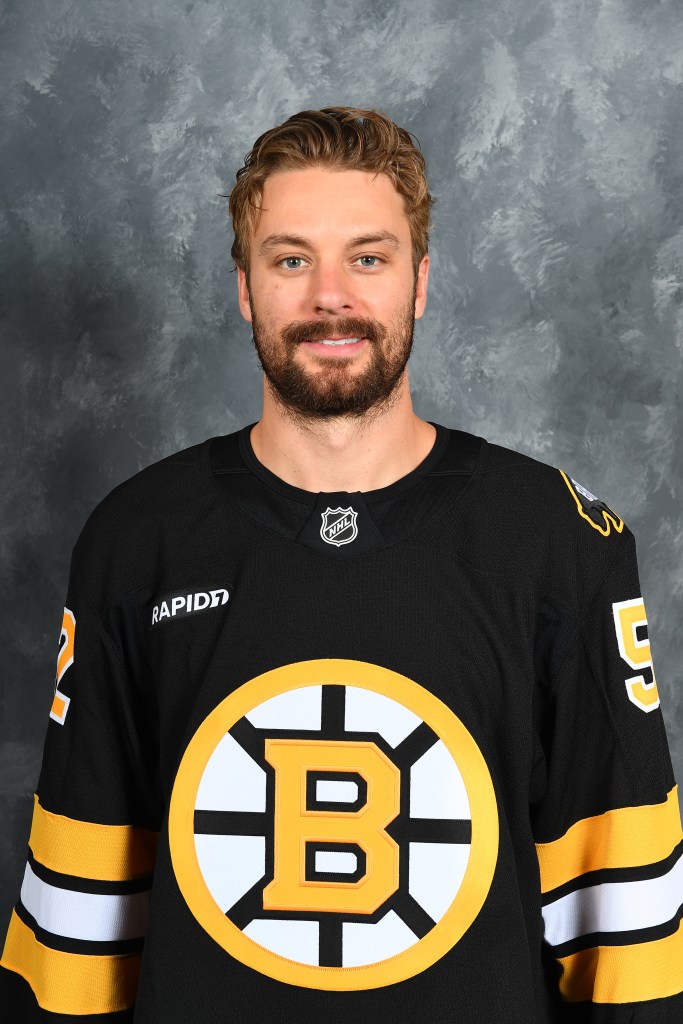
Having been acquired in the flurry of activity that saw mainstay winger Milan Lucic and first-round pick Dougie Hamilton traded to west-coast teams, Sean Kuraly was on the ground floor of Sweeney’s tenure that began in 2015. From there, he developed his ideas on how to succeed in the NHL under the leadership of Zdeno Chara and Patrice Bergeron.
A utility centerman and a staple among Boston’s bottom-six forwards, Kuraly was a stabilizing influence as a younger Bruins roster revved up for another run (albeit unsuccessful) at the Stanley Cup in 2019. After the two Covid-affected seasons that followed, his contract was up and it was time to move on – in Kuraly’s case to his hometown Blue Jackets.
While in Columbus, Kuraly was asked about the Bruins as his Blue Jackets struggled to find consistency and become … more like the Bruins. He compared the Bruins to a machine, explaining that it’s difficult to set up a machine and get it running, but once it’s running it becomes hard to stop it.
Much has been made of James Hagens’ recent “rookie lap” before his NHL debut last weekend, coincidentally in Columbus, the event considered a categorical departure from the no-hazing era that lasted until every member of the 2011 Stanley Cup squad had moved on. Hagens’ solo skate has been locally hailed as a bold new era in Bruins culture.
If so, change has not come at the price of what remains important, and Kuraly testifies that the effects of Chara’s, Bergeron’s, Krejci’s and Marchand’s leadership linger around the Bruins.
“Those things, I think, are in the fabric of this team … they are hard to build. They take time to get ingrained into a group of guys. It’s here, and I told them,” said Kuraly, who referenced a chat with Marchand after the Bruins played a game against the Florida Panthers early this season. “A lot of the things that we learned from Marshy and Bergy and Zee and Krech and David Backes, a lot of those things, none of those guys were in the room, but I noticed a lot of those same things were still in the room. So without them there, which I think is just a fantastic compliment to those guys as leaders.”
Having returned last summer via free agency following four seasons in Columbus, Kuraly has now seen up close and personal a second reset of the Bruins’ Hockey Operations Department under Sweeney. Despite the personnel upheaval of which he is a part for the second time of his career, what he has encountered is less of a sense of change and more of a sense of a continuum of culture and leadership. Only this time around the leaders are David Pastrnak and Charlie McAvoy, guys who were the talented young pups and the future of the franchise when Kuraly was a Bruins the first time around.
“They’ve been really impressive to me. I’ve seen Charlie and Pasta in a new light this year, in terms of they’re the same people and they’re the same guy, but they have different roles and more of a leadership role this year,” he said. “Chucky isn’t acting like Bergy used to or Zee used to, he’s doing it in his own way, and same with Pasta. I’ve been really impressed how those two have done it.
“What is it? I mean, I think it’s just things that get ingrained over years, and things you learn from guys, and this is a place where we’re lucky to have that. You can’t take that for granted,” added Kuraly. “I could have walked into any dressing room in the league. I was just lucky to walk into this one.”
Kuraly considers his NHL career the beneficiary of the culture that he now sees hasn’t gone away just because Chara, Bergeron, Krejci and Marchand have. It’s still a big part of what we’re watching with this team.
If the Bruins are to make a dent in these playoffs about to commence with Sunday night’s series opener against the Sabres in Buffalo (7:30 pm, NESN/ESPN, 98.5 FM), then one certainly it’s because their culture has made them greater than the sum of their parts.
The Stanley Cup is at the top of any NHL GM’s list, but 50 wins per every 82 games played isn’t too shabby.
Management teams in every sport aspire to this kind of success. They all want to win championships, but they all believe that playoff success is built atop a winning culture and the regular-season success that it brings.
The Bruins are not outliers on this. No one in pro hockey, at least, believes a team should cut the ropes and sink to rock bottom on purpose in hopes Bobby Orr will be waiting to propel that team from the bottom to the top.
Failure is not a realistic pursuit to begin with, and tanking is not feasible among so many other teams with comparable drafting opportunities. The teams that are apparently making such an effort are only doing so because the more conventional path of successes perpetuating more successes (i.e. winning culture) is not available to them.
So here were the Boston Bruins 14 months ago, watching their 2024-25 season slip away. Jeremy Swayman hadn’t been Jeremy Swayman because he had no training camp because he had no contract (blame who you want), and Hampus Lindholm (broken kneecap) and McAvoy (shoulder surgery) were lost to the cause. When management and Marchand reached a contract impasse, the Bruins huddled and made a bold decision.
It would be the lesser road traveled: Sell but do so in such a manner that the restoration of competitive credibility becomes attainable for 2025-26.
At the March 2025 deadline, the Bruins traded Marchand and fellow impending free agents Trent Frederic and Justin Brazeau, along with – and this is a biggie – regulars under contract including Brandon Carlo and Charlie Coyle.
The Bruins realized Fraser Minten in the Carlo trade, took back Mittelstadt to balance Colorado’s cap in the Coyle trade, and acquired Marat Khustnudinov in the Brazeau trade. They also executed a pair of under-the-radar swaps, a fourth-round pick to Buffalo for pending UFA Henri Jokiharju (whom the Bruins re-signed last summer) and a fifth to Edmonton for Viktor Arvidsson, whose contract is up this year.
With their own pick, the Bruins drafted Hagens seventh overall. The Carlo and Marchand trades will yield first-round picks from Toronto and Florida, and both may slide to 2028. If Will Moore develops into a NHL center, the pick used by Boston to draft the Boston College skater can be traced to the Frederic trade.
That is not all. If the Bruins draft with some success over the next three years, then Decision 2025 will become a PowerPoint presentation for general managers in multiple leagues if not sports.
As team president Cam Neely alluded last summer, the task of shaping the Bruins’ 2025-26 roster was challenged by the flurry of 11th-hour signings in which rival teams kept some impact players that had been heading toward the open market.
Like 2005, the Bruins didn’t get the targeted talents they had hoped would become available on July 1. Sweeney avoided mistakes made in 2005 by resisting a one-for-one attempt at finding reasonable facsimiles of each player lost. With slim pickings, he changed the make-up of the team so that the Bruins would, whatever else, be a tough out.
In fairness to 2000-06 GM Mike O’Connell, his circumstance wasn’t voluntary. He was saddled with an exodus of players he had acquired because of decisions made over his paygrade as NHL owners approached the lockout year that brought about the NHL’s first salary cap.
Applied to 2025, it would not have been prudent seek doppelgangers for Carlo and Coyle. Rather, Bruins management reformulated what it would take to restore the competitive resilience that had gone missing from the 2024-25 team as a whole.
This wasn’t going to work widget for widget. It was going to have to be about what kind of team the Bruins were going to be.
On multiple occasions, Sweeney has put his pro scouts on the podium to take bows for the advice to acquire Viktor Arvidsson, Jonathan Aspirot, Mikey Eyssimont, Tanner Jeannot, Henri Jokiharju, Sean Kuraly, Marat Khusnutdinov, Fraser Minten, Casey Mittelstadt, and Alex Steeves, all players who got here in March 2025 or last July.
Trading Carlo and Coyle from a team needing to revive its compete level is a touchy subject because it’s a difficult equation without indicting two players and great guys who had worked out so well for Boston for several years.
The Bruins were pleased with their body of work, but hockey has a way of rearing its ugly head as a business. In this case, with Carlo’s career in a lull and Coyle categorically on the back nine, the seller’s market of 2025 presented the Bruins with a rare opportunity to recoup picks and prospects, something Sweeney did upon taking over for Peter Chiarelli 10 years earlier.
Years of Cup contention and investing draft capital in deadline acquisitions eventually breaks every perennial contender’s bank. When the feasting stopped in Boston and the check came due, the executive branch determined that Sweeney was the guy to fix it. This time he has gotten his own chance to engage that unpleasant cycle, but without the championship Chiarelli won, Sweeney has his detractors.
One thing, however, that people should understand about Sweeney: He’s an improver, starting with himself. Team Canada has noticed along the way and integrated him into the country’s thinktank for international competition.
The years have put wrinkles on his forehead, some of those being some combination of age and physical fitness, and some because he’s thought long and hard about the Bruins and how to improve the team. Sweeney has held endless conversations with advisors, colleagues, mentors, and even us, the pundits.
We actually had a one-on-one before a game in the fall so I could focus on his decade at the helm of the Bruins for The Hockey News’ annual Money/Power edition. Sweeney’s experience participating in, arguing with, listening to, and helping along Team Canada was something he was wired to discuss because of all the great hockey minds in that war room and what he described as the complete absence of ego. He relished the experience and obviously takes into account what he’s learned over the years when it’s time to hire an Evan Gold, Jamie Langenbrunner, Marco Sturm or any one of his other members of Bruins management and coaching staff. Some of this staff is destined for the top job in another NHL city if not this one.
One more cautionary tale for those who cling to the notion that it would have been better to let the machine run out of gas rather than keep it going.
The 1996-97 plunge to the very bottom that yielded Joe Thornton first overall (coincidental with Sergei Samsonov at No. 8, the last of three first-rounders that came from Hartford in the 1994 trade for defenseman Glen Wesley (preceded by rangy defensemen Kyle McLaren in 1995 and Johnathan Aitken in ’96) yielded one playoff series victory over Carolina in 1999.
There are no guarantees.
Bolstered by the youthful trio of Jason Allison, Anson Carter and 1996 Vezina Trophy winner Jim Carey from the March ’97 blockbuster that sent a disgruntled Adam Oates, Bill Ranford and Rick Tocchet to Washington, Thornton and Samsonov were supposed to change everything for the Bruins, under the tutelage of Hall of Fame fix-it man Pat Burns and approximately a half-new team including prospects Hal Gill and PJ Axelsson and offseason acquisitions Ken Baumgartner, Rob DiMaio, Dave Ellett, Dmitri Khristich, Grant Ledyard, Darren Van Impe, Mike Sullivan, and Tim Taylor.
The 1997-98 Bruins still had Ray Bourque, and Bourque still had game.
That’s why the interpretation of his March 2000 trade request as desertion misses what actually happened. Had Bourque not cared about the Bruins, he would have left with Oates in ’97, when Bourque was 36 years old and still full of 27-minute games. Bourque stuck it out and was a major part of this rebuild, and the Bruins went from last overall in a 26-team NHL to a 91-point 1997-98 and a return to the playoffs.
When he did request the trade late in the winter of 2000, he was 39 and, for the first time ever, had lost his competitive edge. He thought he might be finished and, with the Bruins out of the running after key injuries compounded offseason budget decisions resulting in a roster unable to weather the storm, he found himself playing poorly and could not find the switch.
Without a trade, Bourque would have hung up his skates in 2000. He asked Harry Sinden if he could go somewhere and find out if he could get himself going. He wanted Philadelphia and Eric Lindros, Sinden liked the Avalanche.
This isn’t the NBA where players can trade themselves and chase championships, and it doesn’t even work in basketball where so few players can make such a significant difference. That Bourque wound up winning the Stanley Cup in his second (and final) try with Colorado is storybook stuff, and he still wishes he could have won it here. I digress.
As Sinden once explained to a novice hockey writer, “you never try to lose.”
Enjoy the playoffs, and the beginning of this new era of Bruins hockey that will always seem somewhat familiar, no matter how many of the names on the backs of the sweaters change.

