There is no reasonable doubt that the Boston Bruins are headed for the 2026 Stanley Cup playoffs, which is quite a comeback story and a lesson for teams that think full-out tank is the way to go. A trade-deadline tank is one thing, shutting down aching players – season-ticket holders be damned – but the Bruins serve as an excellent example how a team can raise the white flag on a season and restore credibility with some shrewd personnel moves at the deadline and over the summer.
Beyond the obvious task at hand, some random thoughts on the final weekend of the 2025-26 NHL regular season…
James Hagens is here because a wedding gets a honeymoon. Note that coach Marco Sturm is holding out the newcomer pending the clinching of the playoff spot. Once that mission is accomplished, it’s a good bet Hagens makes his NHL debut tomorrow night in Columbus. If the Bruins somehow make it to Sunday with the season still on the line, then all bets are off.
I don’t like talking or writing about fans’ opinions. Lord knows I’ve made many opinions over the decades, and we only like to talk about the ones that worked out for us.
So, sticking with the hockey and the business of hockey, this burning of the first year of the former Boston College star’s NHL rookie contract was a negotiations. It’s not the road more traveled, and I suspect the emerging story that BC teammates Andre Gasseau would rather go to the free-agent market (as is his right) got the Bruins’ attention. They needed to get this kid signed. He’s signed and in the fold.
Now Hagens’ ability to compete will determine where and when we see him in action next. Hagens was far from dominant in his short AHL stint since joining the Providence Bruins, a team with which he would do well to continue developing as a professional playing against grizzled veterans.
Right now he’s here in Boston with the NHL team, and while I think the great Rick Bowness did the right thing with the early ’90s Ottawa Senators, skating Alexei Yashin, Radek Bonk and Alexandre Daigle on separate lines between journeyman plumbers, it makes no sense to integrate Hagens here and now in that fashion. Unlike at least Yashin and Bonk, he’s physically not ready for this. If he does get in, better to play him with David Pastrnak and see if he can contribute in some manner to his strengths, offering the things he can offer right now. That is not a viable plan for winning in the playoffs, but we’re at the end of the season, so it’s about success, not development.
The division-centric Stanley Cup playoffs: Is it a good format or would 1 vs. 8 and 2 vs. 7, etc., fix it? No playoff format is perfect, but for a playoff format to be fair it must reflect the regular-season schedule, whatever that is.
Since the NHL sent the Chicago Blackhawks to the West Division in 1970, ending that weird, three-year run of 1967 expansion teams playing only each other for two rounds to produce a Stanley Cup finalist (that team was the St. Louis Blues, all three years), the regular-season schedule has fairly reflected on the playoffs and vice versa (until now).
For example, as the NHL continued expanding in the 1970s, adding the Atlanta Flames and N.Y. Islanders in ’72 and then the Kansas City Scouts (who would go on to become the Colorado Rockies before becoming the New Jersey Devils) and the Washington Capitals in ’74, the NHL expanded its regular-season format to four divisions, naming them after hockey icons Charles F. Adams, James Norris, Lester Patrick and Conn Smythe.
The important thing was the regular season offered a very balanced schedule. Teams visited every other city almost equal to their own division, which was fine because the division only came into play where it concerned the first-place finisher, which in the era’s expanding, 12-team tournament, earned a bye to the quarterfinals. The next best eight records in the league were then seeded 1v8, 2v7, etc. The teams were reseeded for subsequent rounds. Play everyone almost equally in the regular season and then be seeded leaguewide for the playoffs. It worked.
When the NHL absorbed the four best surviving World Hockey Association franchises and became a 21-team NHL, divisions continued, but the schedule was balanced, 16 out of the 21 made the playoffs (giving birth to the saying, “in hockey everybody makes the playoffs”), and the teams were seeded 1v16, 2v15. No byes, the first round was now best-of-five, and every round reseeded according to regular-season finish. One newspaper service, on what sportswriters call the “agate” page, published “The Real NHL Standings,” listing the teams 1-16. That was the truth for two years.
In 1981-82, the NHL went from the balance extreme to the rivalry extreme, and the Bruins played against Montreal, Buffalo, Hartford and Quebec eight, sometimes nine times in the regular season. As a result, the playoffs were strictly divisional, no wildcard. 1v4 and 2v3, winners meet, producing a conference finalist. The NHL slightly loosened that format in the 1990s but not a ton.
Things continued tweaking as the NHL, now under Gary Bettman’s leadership, began seeking leaguewide salary control, migrating small-market franchises such as Quebec, Hartford and Winnipeg to points south, all the while seeking to expand the league to nontraditional but high-potential markets.
Throughout all of that economic activity, the NHL maintained integrity of competition until Covid-19 truncated the 2019-20 season on March 10. The league and the players waited for an all clear, and to recover some of the lost revenue, a neutral-sites bubble tournament was created a full offseason after the 2019-20 season had been called off. The NHL called it the 2020 Stanley Cup playoffs. Tampa Bay, which was without Victor Hedman for what would have been an on-schedule 2020 playoffs, had him back for the bubble tournament and was champion of the Covid Cup playoffs.
The reason why 2019-20 remains relevant now is it was only a sign of what was to come: a playoff based on revenue grab irrespective of a fair tournament. 2020 wasn’t fair to the Boston Bruins, who had the best record of the 19-20 season after going seven games in the 2019 Cup final. The Stanley Cup should never have been put up for grabs, much less a full offseason later when the only team anyone with a brain cell knew had no chance of bouncing right back to the hockey it had poured out through 2018-19 and 2019-20 was the Bruins. The 2020 playoffs were a joke and an insult to the trophy the NHL promotes as the greatest in sports.
Fast-forward to 2025-26: The current system does not guarantee the injustice that this year’s impending Stars-Wild series presents. Two years ago, a 1v8, 2v7, etc., conference tournament would not have changed the opening-round match-ups one iota. But any system is flawed when the regular season and playoffs are not built by the same architect. The NHL has a conflict of interest with itself.
One on hand, the NHL wants to present the Stanley Cup as the hardest trophy to win and the greatest trophy in sports. On the other hand, Stars-Wild guarantees that one of the league’s five best records will be eliminated in the opening round and that a lesser team is guaranteed to make the round of eight. Yes, every season has stunning, opening-round upsets – it’s the juice that makes the opening round must-see TV – but writing a legitimate Cup contender out of the script on systemic error erodes the integrity of the contest.
Why is it the way it is? Follow the dollar is the best way to figure out a likely answer.
Network TV has for years been the NHL’s priority, and that’s understandable considering the league’s owners hired Bettman to show them the way to a more lucrative tomorrow. It’s the recent emergence of sports betting that makes bracket betting the challenge to the playoffs’ integrity.
The signs of sports betting as a controlling influence on operations is evident in the many multi-million dollar scoreboards that have replaced perfectly good video boards across major-league arenas, not only offering viewers an even bigger screen with even higher definition but, most importantly, constructed so as to used its inside walls to provide for the closest seats the information needed to make wagers during games.
Like it or not, these are the levers controlling the NHL’s playoff format, TV and gambling. The one way to make it a fair tournament is to go back to a rivalry-centric regular-season schedule, but if that means Connor McDavid doesn’t come to Boston, the league is equally determined not to let that happen. Too many years, Bettman heard that the NHL doesn’t promote its stars, lest they have to pay them. Well now they get paid, so it’s McDavid to 31 other NHL cities tour and a playoff that has a bracket so the sports-betting industry can maximize it. That renders Stars-Wild as tough luck.
That’s the game now.
TODAY’S GAME
The Bruins took the ice this afternoon with the energy of a team playing the deciding game of a playoff series, and that’s really how the season has been for them.
The Lightning had nothing to play for, except that little thing of being the Bruins’ daddy, which of course is no little thing. They weren’t about to mail it in against a Boston team that, more than anything else, needs belief against the Bolts should they meet in the first or second round of the playoffs.
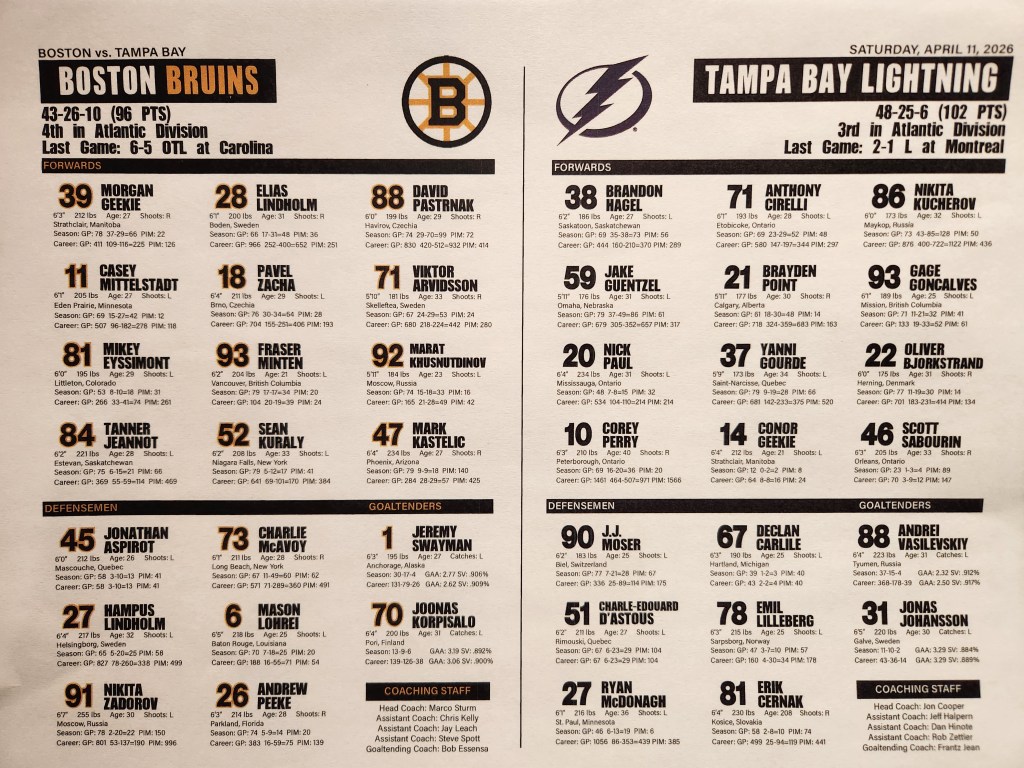
It was the kind of crowd reaction you wish you could bottle, as Charlie McAvoy deftly turned to avoid a steal in the circle to Jeremy Swayman’s left viewpoint, then fired a headman pass to Morgan Geekie, who had the runway for a clean breakaway from the blue line in. Geekie looked, maintaining speed, and fired his wrist shot past Andrei Vasilevskiy glove side for a 1-0 lead just before the midway mark of the game. TD Garden was given the full opportunity to see the opportunity develop, react to that while anticipating the finish, and then erupted as Geekie snapped the puck cleanly past the big Russian netminder. The Lightning had been leaning on the Bruins, who pushed back upon the momentum of that counterattacking play.
Speaking of McAvoy, the Bruins sent out a press release announcing individual awards for the 2025-26 season.
BOSTON BRUINS ANNOUNCE 2025-26 SEASON AWARDS
The Bruins announced today, April 11, the recipients of the 2025-26 season awards.
Charlie McAvoy has been named the recipient of the Eddie Shore Award, given to the player who shows exceptional hustle and determination, as chosen by the “Legacy Season Ticket Holders.” Jeremy Swayman has been chosen as the winner of the Elizabeth Dufresne Trophy, awarded to the player exemplifying outstanding performance on home ice as determined by the Boston chapter of the Professional Hockey Writers Association. Jordan Harris has been selected for the John P. Bucyk Award for providing exceptional off-ice charitable contributions, chosen by John Bucyk. Jeremy Swayman (First Star), David Pastrnak (Second Star) and Morgan Geekie (Third Star) have been named the Bruins Three Stars, as selected by 98.5 The Sports Hub, for being top performers at home games over the course of the season.
Eddie Shore Award
Bruins defenseman Charlie McAvoy has been selected by the “Legacy Season Ticket Holders” as the 2025-26 Eddie Shore Award winner for demonstrating exceptional hustle and determination throughout the season. The 6-foot-1, 211-pound defenseman has appeared in 67 games with Boston this season, recording 11 goals and career highs in assists (49) and points (60), despite sustaining a fractured jaw and multiple mouth injuries just 19 games into the season. The Long Beach, New York native ranks 10th in assists among NHL defensemen, and ranks second for assists, fourth for points, tied for fifth for plus-minus (+13), fifth for even-strength points (37) and third for powerplay points (23) on the team.
Elizabeth Dufresne Trophy
Jeremy Swayman has been selected as the Elizabeth Dufresne Trophy recipient for the 2025-26 season for his outstanding performance on home ice this season. Through 25 starts at TD Garden this season, the 6-foot-3, 195-pound goaltender has compiled a 18-6-1 record with a 2.27 goals against average and a .917 save percentage. The Anchorage, Alaska native ranks tied for fourth among NHL goaltenders in home wins (18), tied for first in save percentage (minimum 15 games started) and third in goals against average (minimum 15 games started) on home ice this season.
John P. Bucyk Award
Jordan Harris will receive the John P. Bucyk Award for his contributions in the Boston community this season. Harris has been involved in several community events including the team’s annual holiday toy shopping and delivery for pediatric patients at local hospitals. Harris also took part in several meet-and-greets at the team’s home games while recovering from injury, including a visit with cancer patients during Hockey Fights Cancer Night. In December 2025, Harris attended the 8th annual “Operation Warm” coat drive to provide winter gear to children in need across Massachusetts. Throughout the season, Harris has partnered with SCORE Boston, a nonprofit organization focused on supporting youth who would not otherwise have the opportunity to participate in hockey, to host clinics as part of his Harris’ Huskies program. The award is named after Bruins legend John P. Bucyk, who is in his 68th season with the organization.
98.5 The Sports Hub Three Stars
Bruins First Star Jeremy Swayman has compiled a 18-6-1 home record with a 2.27 goals against average and .917 save percentage in 25 home starts this season.
Bruins Second Star David Pastrnak has appeared in 35 home games this season, tallying 11 goals and 36 assists for a team-high 47 points.
Bruins Third Star Morgan Geekie has skated in 38 home games this year, recording a team-high 20 goals and 11 assists for 31 points.
#04/11/26#
 Rink Rap with Mick Colageo