Lionel Hitchman’s No. 3 is the continuously longest retired number in sports history, and it’s only fitting that the player whom Sports Museum Richard Johnson argues gave the Boston Bruins their culture that Zdeno Chara’s No. 33 takes its spot as a bookend.
Separated by a century’s worth of hockey, it turns out No. 33 and No. 3 have a lot in common.
Hitchman was the Bruins’ steadying influence, the player who skated in Shore’s shadow but provided the Bruins with an identity in terms of how they played as a team. So did Chara when the Bruins were without a rudder in the wake of the May 2000 Raymond Bourque trade.
GM Mike O’Connell’s early 21st century teams were physically huge, and in three full seasons at the helm his teams earned a first-place finish in the conference in 2001-02 (second to eventual Stanley Cup champion Detroit) and a second-place finish in the conference in 2003-04 (second to eventual champion Tampa Bay), but post-Bourque and-pre Chara, the Bruins lacked identity.
Former Bruins captain Joe Thornton, who would be inducted by the Hockey Hall of Fame alongside Chara in the Class of 2025, was a more accomplished player during the same segment of his own career, but the time and place wasn’t the same for him as it was when Chara arrived after the 2004-05 lockout, after the management upheaval of 2006 when July 1 coincided with his own opportunity to choose a new destination, a new city, a new team and a new mission.
Chara could have taken the road so many athletes in that enviable position do and chase a championship with a dynastic team or at least a contender. Instead, he chose Boston because he wanted to be a player who would have a foundational role and making all those wonderful things happen.
The man Chara singled out at his Hall of Fame induction, Patrice Bergeron, was asked during their first season together, a most-chaotic experience that ended outside the playoffs, if anything resonates from that time that impressed him as to confidence that Chara was the guy to lead the Bruins forward.
“My first encounter with him was in the gym – which is very fitting by the way,” said Bergeron, alluding to early conversations with the new captain and the respect he showed for all other players. “I just saw, first hand, his work ethic, he was exciting to be around. … From the get-go I knew he was the right guy.”
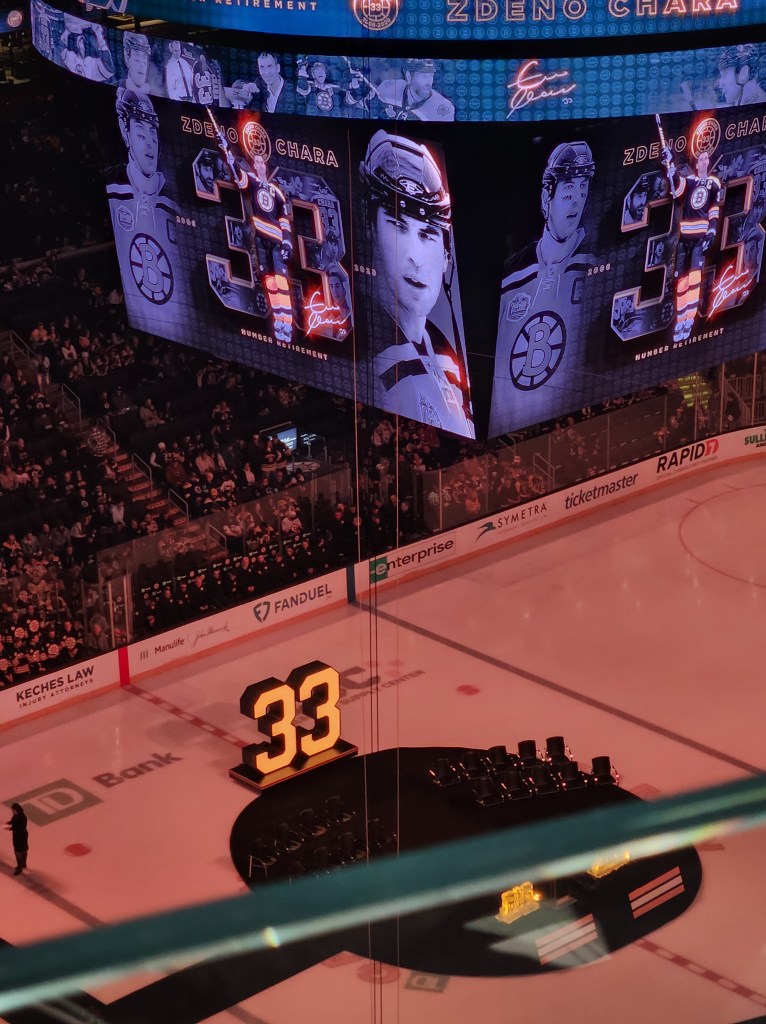
Master of Ceremonies Andrew Ference said that all of Chara’s Boston teammates were better players and better men for having played with him, that Chara’s professional career was based on the stick-to-it-ive-ness that made him come back and try again after getting cut by his youth-hockey team.
When the Bruins were ready for a cultural reset, Chara was ready to be the guy who would give it to them.
It was with all these thoughts in mind that Bruins from the past and present assembled with a sold-out TD Garden to celebrate his career and observe as his No. 33 banner was raised to the arena’s rafters, never to be worn again by a Bruin in a NHL game.
Chara thanked the Bruins, his parents and his sister for teaching him humility and respect and for everything they had given him long before championships, awards and financial rewards.
“Nothing can beat that moment in 2019 when I stood before you brokenhearted and you had my back,” he said, referencing the June 12, Game 7 loss to St. Louis on TD Garden ice.
As Chara left the podium, the fans started a “Thank You, Chara!” chant. He would later tell the media that moment almost made him cry. “I was very close.”
Reading aloud the names of his 2010-11 Cup-champion teammates, Chara reminded us how special and deep a group of hockey players that was.
It didn’t happen overnight, and had Chara chosen a team where winning was already a way of life, he would have missed out on a more-rewarding experience. Without any guarantees, he made the choice to join the Boston Bruins at a time when the Patriots and the Red Sox were enjoying enormous success, when the Celtics were on the cusp of their first championship since their No. 33 years (Larry Bird) but when the Bruins were, in Chara’s words, “desperate to win.”
It was a match made in heaven.
Chara insisted tonight that his choice to come here at GM Peter Chiarelli’s beckoning “wasn’t reckless. I did my homework.”
He knew the Bruins were committed to recovering excellence. No one knew how much they would achieve with Chara as their on-ice rudder, how his commitment and defiant belief would bring back the franchise to a place of prominence in the city and spawn many more years of success, even after he had left to finish his NHL career in Washington and, finally, with the N.Y. Islanders, the team that broke him into the bigs in the first place.
Now No. 33 sits up next to No. 77 and down the line from No’s. 2, 3 and 4, all history-changing defensemen whose impact on hockey in Boston is appropriately memorialized.
 Rink Rap with Mick Colageo