The National Hockey League trade deadline is not today, it’s March 6, and the way this season is going, don’t expect a repeat of what General Manager Don Sweeney did at last year’s trade deadline. With 41 games down – the halfway point of the Boston Bruins’ 2025-26 season – there are 20 more games to play before the trade deadline.
Heading into tonight’s tilt in Vancouver (10 pm ET, NESN, 98.5 FM) and with half their body of work in the books, the 21-18-2 Boston Bruins sit outside the Eastern Conference playoff eight. Their .537 points percentage ranks 14th out of 16 teams, but the Bruins are separated from the playoff line by just two points, having played just two more games than the eighth-place Buffalo Sabres, who – oh, by the way – are on a 10-game winning streak.
Lindy Ruff.
I digress.
Is now the time to clear the deck, fold the tent, and call it off?
The strange and spectacular ups and downs of the 2025-26 NHL season have had the Bruins looking like they’re one top-six acquisition from a deep playoff run in one week and, in another week, flirting with a second consecutive spot in the league’s draft lottery.
Further blurring a sustainable view of this oscillating plight has been the Eastern Conference at large; the majority of the 16 teams are one good week from a great-looking spot in their divisional top three and one bad week from that slippery slide.
Until the Bruins showed sparks of life in a tough loss at Calgary followed by a New Years Eve romp over a flat Edmonton team, the noise around the B’s had been deafening: “Sell!” (A close second has been “Neely and Sweeney need to go!”) Now it’s back to the more usual quiet observation with the finger tapping lightly on the blow-it-all-up button.
But why?
While it was theorized that, with reasonably good health and a strong training camp, this team should defend consistently and grind out enough offense to make the playoffs, the plan has never been playoffs or bust.
The larger plan is going to go forward as mapped out regardless of what transpires over the next 20 games. There will be evaluations and decisions on individual players along the way (see below), but the long-term plan governs how the Bruins will execute any emerging short-term plan.
Because they have played more games than the vast majority of other teams, the Bruins’ mental and physical fatigue has been exacerbated by the compacted, Olympic-year schedule. It seems as though the Bruins are digging their way out of their most-recent doldrums, but nothing is guaranteed, especially for team that needs all hands on deck. They can only hope on the other side of February’s three-week Olympic break that they’ll still be in the playoff race and that their division and conference rivals for the two precious wild-card spots will be feeling what they felt throughout December.
Vancouver (16-20-4) is a horrible 4-12-2 at home and a better-than-Boston 5-4-1 in their last 10. After going 6-3-1 in their last 10, the Seattle Kraken will be waiting for the Bruins on Tuesday night. That’ll conclude the five-game road trip before the Bruins are finally back in TD Garden on Thursday against Calgary. No one needs to tell the Bruins not to count on easy points; there are none for them, especially as presently constituted.
As for those many individual decisions, onto a deeper look at the Bruins at this halfway point of the season. The great Gilbert Perreault was once asked the three elements of the game of hockey, and his answer was, “forecheck, backcheck, paycheck.” Perreault’s good humor notwithstanding, let’s glance at each element as it applies.
FORECHECK: The 2025-26 Bruins roster is an open-face, five-decker sandwich of inner and outer-core players, support players, bridge players, and NHL-opportunity players. A rough categorization might categorize them as follows…
Inner Core (the following players have signed legacy contracts with the Bruins and are fully expected to be in leadership positions when the prospects currently developing in the AHL, CHL or NCAA are making NHL impact): Jeremy Swayman, Charlie McAvoy, and David Pastrnak. Midseason notes: Swayman had his camp and has for the most part been back on track as one of the world’s elite at his position. McAvoy has once again dealt with a horrible injury (broken jaw); he still has more muscle to recover from his absence but is playing well considering; Pastrnak has had a rough go of it for some time now, but his most-recent play seems to indicate he will regain his touch and torch the competition once again.
Outer Core (no one is untouchable, but the following players are also on long-term deals and/or hold core-like status for the foreseeable future): Hampus Lindholm, Nikita Zadorov, Morgan Geekie, Elias Lindholm, Fraser Minten*, and Pavel Zacha. *Minten, 21, is in his rookie deal but was at the center of Boston’s March 7, 2025 acquisitions and is undoubtedly headed toward Inner Core status. Midseason notes: Elias Lindholm should be on the Inner Core list, but he yet struggles to sustain a level of play that isn’t too quiet for a player earning $7.75M AAV; if Sweden took the wrong Lindholm, it might be the best outcome for the Bruins, who need all of Hampus’ energy while secretly hoping the Olympic torch lights a fire under Elias; some considered Geekie a Canadian snub – that’s a great place for Geekie to be in his career – now Marco Sturm needs to get him back on the off wing from whence he does his damage; Zadorov’s alpha-male game is going to have ebb and flow, and it’s great that he can still do great things on nights that he does not-so-great things; Minten I predict will be worth everything the Bruins gave up on March 7, 2025, not just in the Brandon Carlo deal; Zacha continues to lead the Bruins in consistency of effort, and this cannot be overlooked on a team challenged to sustain impactful center play on the top two lines; there are those who would like to see the Bruins cash that chip and get another draft pick, but that would be a tank move, something the Bruins will absolutely not consider before the season chooses it for them (just like last year).
Support (the following players were acquired or farmed up with open-ended intentions): Joonas Korpisalo, Henri Jokiharju, Andrew Peeke, Mason Lohrei, Mark Kastelic, Tanner Jeannot, and Sean Kuraly. Midseason notes: Korpisalo hasn’t been bad, the Bruins have been bad in front of him, and that’s got to stop; Jokiharju was in Sturm’s dog house when he went out of the lineup and onto IR with an unspecified injury; this will become an intriguing crossroads for the Finnish Olympian when he’s ready to play; the Bruins desperately need a right-shot defenseman, and Jokiharju was supposed to be it before he started bouncing off picks set by opposing forwards stationed out by the blue line while teammates were making scoring plays as the Bruins struggled to master the new D-zone-coverage system; Peeke has been a horse, especially when McAvoy was out of the lineup, and is most-deserving of your 7th Player Award vote; Lohrei has been better in a more-protected role; Kastelic has made a triumphant return from a career-threatening string of head hits last season; he’s not the kind of player who can succeed without his ability to hit if not fight; until his own in-season injury, Jeannot had been getting better with each month of the season; Kuraly has been a mixed bag, but he continues to play to the team identity, and that alone is huge.
Bridge (the following players were identified last March or on July 1 whose skills were considered viable in the short term while the Bruins buy time to evaluate their emerging prospect pool): Viktor Arvidsson, Casey Mittelstadt, Mikey Eyssimont, and Jeffrey Viel. Midseason notes: Arvidsson throws his body into the fray and gets banged up; it’s hoped that he can withstand the beating he takes for playing the way he does; the second-line chemistry he helped create once Sturm moved Zacha to center, switching Mittelstadt to the left wing where his elite eyes and soft hands can make winning plays, depends on a healthy Arvidsson and a hard-skating Zacha; Eyssimont is capable of the spectacular but just fine when he’s frustrating the opponent; Viel was looking like a modern-day Louis Sleigher wrecking ball when in the lineup before Radko Gudas almost broke his skull with that wrestling move when they met at center ice for what Viel thought would be a punch-a-thon.
Opportunity (tweeners whose acquisitions were meant to create a more competitive training camp and/or hopefully capitalize on their unrealized NHL potential): Jonathan Aspirot, Jordan Harris, Vladislav Kolyachonok (midseason acquisition via waivers), Marat Khusnutdinov, and Alex Steeves. Midseason notes: Aspirot is the 2025-26 version of Parker Wotherspoon, buried for years in the AHL and ready when they finally got their NHL opportunity; Harris only briefly (5 GP) had the opportunity to show his skills before spending the rest of the first half of the season on LTIR; Kolyachonok is a former second-round pick of the Panthers with some NHL experience; Khusnutdinov was a second-round pick of the Wild, and as long as he continues to compete and play a smart game, the Bruins will give him opportunities; Steeves knew he had not scored enough in camp to make the NHL roster, but his development as a physical winger and his attention to detail on both sides of the puck helped him earn a recall that has staying power with 8 goals in 24GP.
BACKCHECK: The Bruins are presently constituted thanks to tough decisions made necessary after McAvoy’s and Hampus Lindholm’s 2024-25 seasons were lost to injury. The 2025 trade deadline presented Sweeney with a market to recover draft capital previously lost over several years of Stanley Cup contention. Along with the decision to trade captain Brad Marchand rather than meet his price on a contract extension, sending Brandon Carlo to Toronto and Charlie Coyle to Colorado were meant to maximize a franchise reset similar to the one Sweeney executed in 2015 by trading Dougie Hamilton and Milan Lucic. The result can only be partially realized over the next three years, but Minten’s age-21 season and the individual performances of collegiates James Hagens and Will Zellers in the World Junior Championships have Bruins management in a hopeful place. The Bruins have several other legitimate prospects in the pipeline now that full closure to 2011 has been realized with the trade of Marchand to the Florida Panthers and the uniform change that reflects on the closing of Marchand’s era much as the curtain was brought down on the Big, Bad Bruins a half century ago.
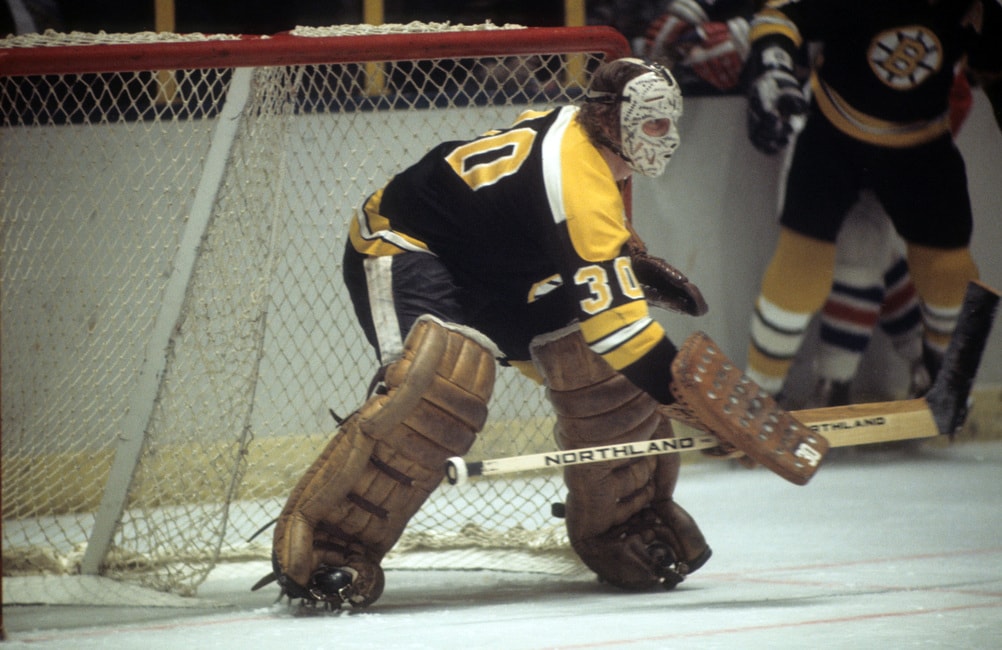
Gerry Cheevers circa 1971-72.

Cheevers after returning from the World Hockey Association in February 1976. Note the familiar uniform change.
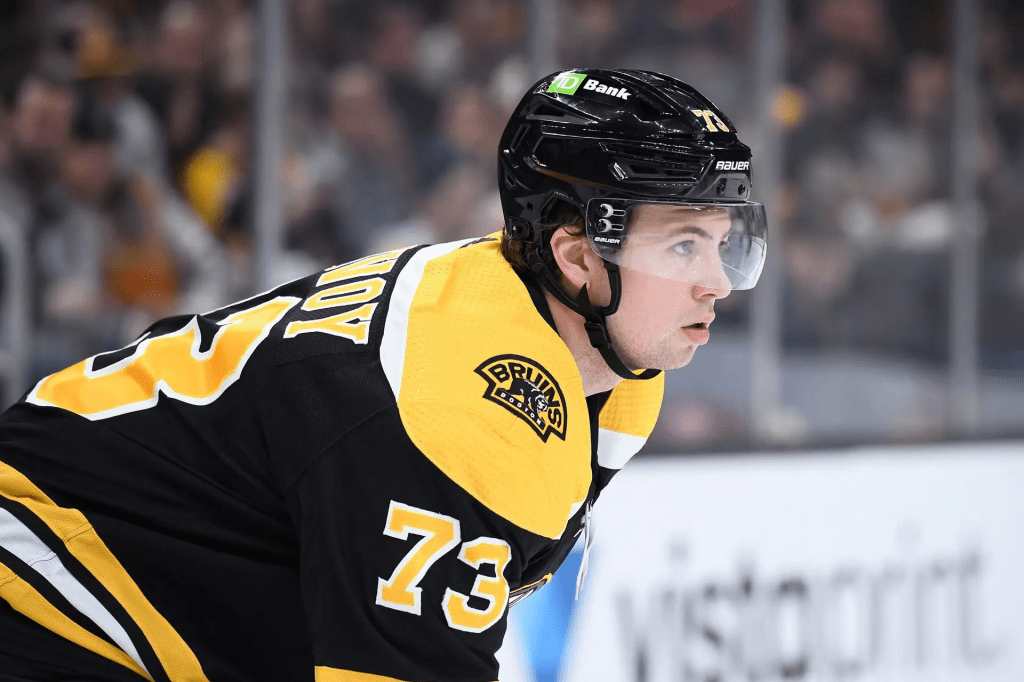
Charlie McAvoy in the 2007-25 Bruins home black.
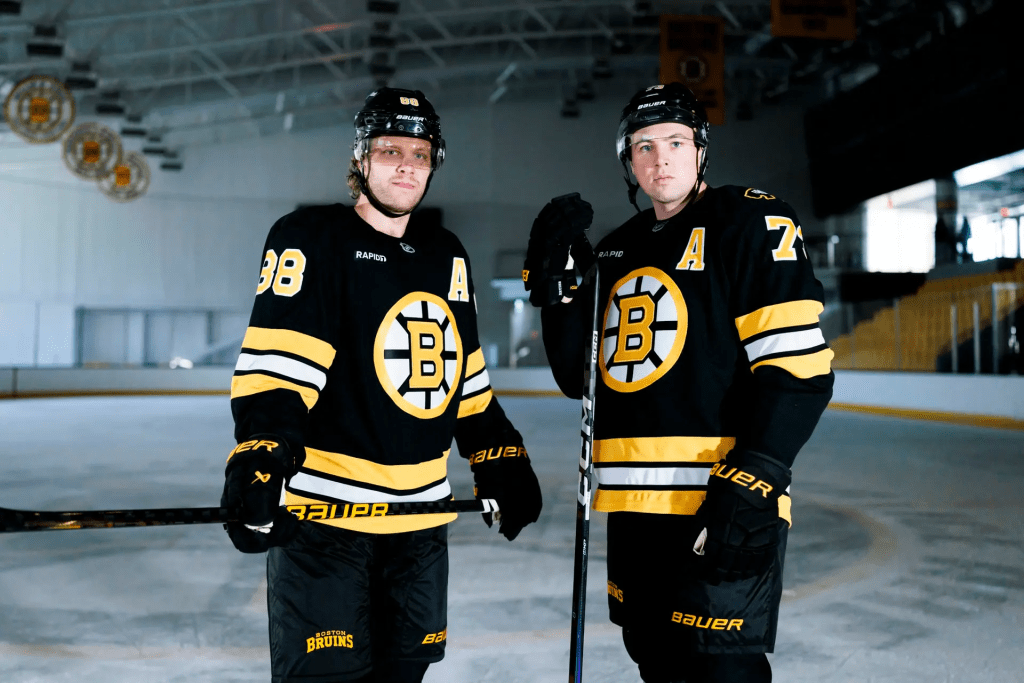
David Pastrnak and Charlie McAvoy in the new unis.
Meanwhile in Providence: Speaking of second-round picks, center Matt Poitras is apparently being given a full season to hone his pro game against AHL competition. After producing at a point-per-game clip (17-24-41 in 40GP) for the P-Bruins last season, a slow start to this season has held him to 6-12-18 in 29GP; Dans Locmelis (11-8-19 in 29GP) is probably the only other forward in whom the Bruins brain trust holds substantial NHL hope. Should Brandon Bussi’s NHL breakthrough with the Carolina Hurricanes change how Boston views Michael DiPietro and/or Simon Zajicek? No. Bussi’s next dozen opportunities will tell them more so if they sold the late bloomer short. Right now, it’s a feel-good story with a recent hiccup and a lot of hockey left to play. Frederic Brunet has emerged as the best defense prospect in Providence, but right now he ranks no better than seventh among left-shot defensemen in the organization (not counting Quinnipiac sophomore Elliott Groenewold). We won’t delve into the college prospects except to note that Groenewold was not eligible for Team USA because the sophomore defenseman from Springfield, Vermont, turns 20 on February 4. That’s almost 10 months too soon according to eligibility rules.
REALITY CHECK: Getting really bad as a necessary prerequisite to getting really good may hold truth in the NBA but not in the NHL, where the climb to the top is a grind of a process and rarely linear. “Look at Edmonton sinking to the bottom to get Connor McDavid” might be the laziest sports argument of all time because it took the Oilers three first-overall picks in a six-year period to get their generational talent, and 10 years into the career of the consensus world’s greatest player’s career, the Oilers are a two-time close but not quite.
The proven method for former champions to reformulate Stanley Cup contention in partially separated eras has been to retool around existing Cup-contention cores. The Bruins finally ran out of runway with the Patrice Bergeron/David Krejci model and find themselves searching for fresh, new personnel to fill those holes, all the while shifting maturated excellence to the defense core made up of McAvoy, Zadorov and Hampus Lindholm. Given there are three-zone skills among the trio but no elite offensive talent, the next acquisition of a right-sider might be a powerplay quarterback. Heretofore, Peeke has been an ice-time Cookie Monster. Jokiharju is at a crossroads. Maybe the right move for the Bruins is to start trying hard to find themselves a Hughes/Hutson/Schaefer type, even if said player is a third-pairing specialist and not capable of matching up in the top four. The Bruins recently discovered that Lohrei, despite his obvious skill, doesn’t back defenses off the blue line well enough to offset his defensive shortcomings. McAvoy will never have Krug-like acumen off the point, despite the brilliance he shows playing the two-way, 5v5 game at top speed. Alas, he is more Scott Stevens than Scott Niedermayer, and there is nothing wrong with that, even if it comes in a speedier package. It might take several years before the Bruins can acquire or draft/develop their next great offensive defenseman. Nonetheless, the Bruins are looking like the goalie, the Big Three D, an elite line-driving winger, and a batch of questions at the center position.
This is going to take time. The answers may or may not be hiding in plain sight. That’s why the next 20 games leading up to the trade deadline remain early stages for Bruins management in its quest to put a Stanley Cup contender back on TD Garden ice.
Try to enjoy the ride, as bumpy as it gets. These next few are formative years, so how each one concludes is of far less importance than the linear progress toward rebuilding the forward lines in time to get Pastrnak and company a well-deserved shot at glory.
Meantime, Pasta will get Zacha and his other Czech countrymen ready to try and upset the apple cart in Milano.
 Rink Rap with Mick Colageo