Before adding my little bit to the excellent and heartfelt tributes I’ve read on Facebook, I encourage anyone really seeking to understand why the loss of Ken Dryden shakes the ground under the rink of so many older hockey minds to find the Facebook post authored by Sports Museum curator Richard Johnson and the tribute written on NHL.com by Dave Stubbs. These two friends are by far my favorite English-speaking authors on all things Montreal Canadiens, and in this case the work carries their signature excellence. Losing Dryden was personal to both as young hockey fans. I can obviously identify with that, and I join them in recommending “The Game,” Dryden’s memoir built around his final NHL season (1978-79).
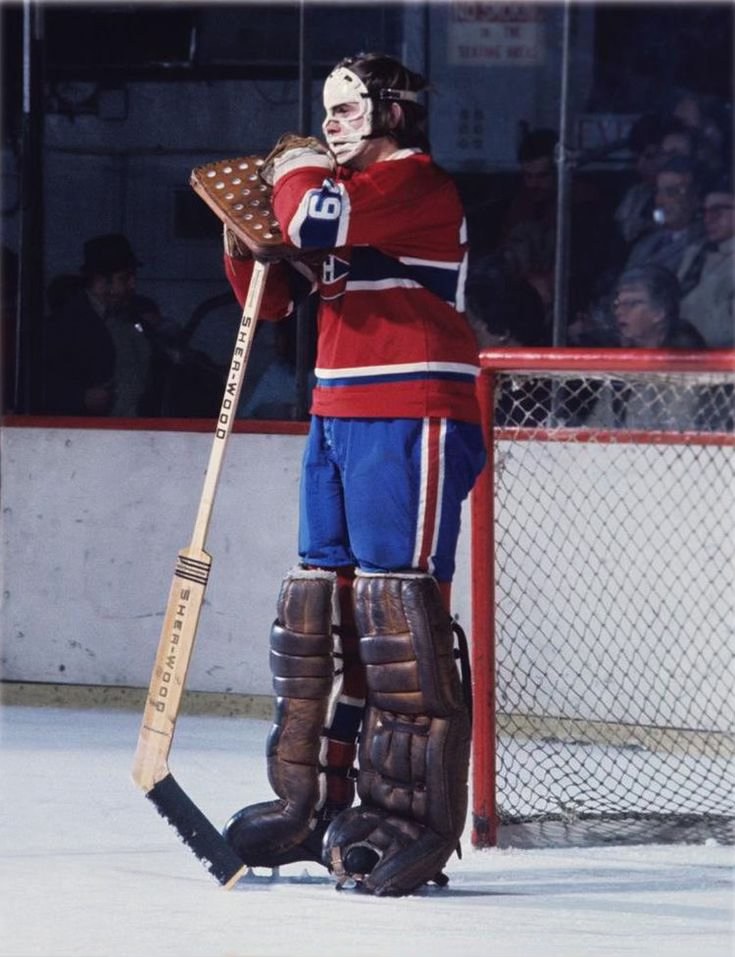
Whatever else, Dryden was an original thinker who, as he reveals in “The Game,” felt somewhat separate from his teammates on that late ’70s Montreal juggernaut.
The above pose (if Dryden were to get a statue, please make it this), mostly likely taken during the Canadiens’ infamous, 1971 Game 7 upset of the defending champion Bruins at Boston Garden, is not my first memory of Dryden, but it’s the predominant one, the indelible one, the one that had me tossing a tennis ball off Larry Johnson’s full-page, Boston Globe Bruins portraits that I’d plastered on the walls of my bedroom. “It’s not his fault,” I’d say, bouncing the ball off one of the broadsheet, newsprint pages as time ticked away on the third period of a Game 7 decided.
I wasn’t following Dryden’s career from the time the Bruins made him the 14th pick (the third round!) in the NHL’s second-ever (1964) entry draft. In its initial incarnation, the entry draft was an event for players not subject to the dominant system of the day in which NHL teams sponsored particular junior teams and thereby held the NHL rights to those players. I recall seeing Dryden on TV playing for Cornell, but I was just becoming acquainted with hockey via Coburns Pond in East Walpole, Mass., 4 Seasons Arena up the hill where Route 1 meets Route 27 and where I saw Norwood’s Richie Hebner and my future relative Bill Hasenfus, Walpole’s Kevin Woods, Peewee Giandomenico, Mike Milbury, Needham greats Dan Eberly, Robbie Ftorek and his goalie Cap Raeder and, in a preseason game vs. St. Lawrence, Boston University’s Herb Wakabayashi.
In the mid 1960s, the Bruins were accessible mainly via Fred Cusick’s “Bruins Highlights” show he created and got to Channel 56. The 30-minute, weekly program aired at noon on Sundays. The Quincy Patriot Ledger sports section ran a photo collage one day during the 1967-68 season of a Bruins game, including a “birds-eye view” of the action.
I’d heard of Ken Dryden, but he was just a tall goalie who much later would become a dominant figure in hockey throughout the 1970s.
The no longer little-known fact he was originally drafted by the Bruins has become the laziest of low-hanging fruit to bash management. Most of the bashers cannot even tell you who was managing the Bruins at the time they let him go.
The draft, brand new the year before (1963), was not the primary way NHL teams procured talent, not until 1969.
In the ’60s and prior to for some years, the NHL had six teams, and their amateur scouts would make long sojourns to Canadian outposts to look at a couple of promising players, all the while hoping to return to their NHL managers with the news of some unknown teenager who was going to change the landscape of the sporting world (Bobby Orr). The earliest version of the NHL entry draft was almost a waivers kind of draft, but Peter Mahovlich once reminded Rink Rap that he went second overall in the initial (1963) draft. Brad Park was also chosen via the entry draft. The NHL Draft began in earnest in 1969 after sponsorship arrangements had been completely phased out.
From Dryden’s draft year to the day he interrupted what the hockey world had figured would be several years of Boston dominance, seven years had passed. Even the previously dynastic Canadiens, after missing the playoffs on the final day of the 1969-70 season, needed most of what had been a mediocre 1970-71 season (the final season of the great Jean Beliveau’s career) before firing coach Claude Ruel and promoting Al MacNeil from the minors. Late in the season, MacNeil’s recommendation that Montreal also summon Dryden from the AHL Voyageurs was heeded.
If anyone knew that these moves would turn out to be the mother of all coaching changes/goalie changes, providing the all-time template for avoiding the iceberg and instead celebrating champagne on ice, certainly it would have all happened the year before when the Habs wound up on the outside of the playoffs.
The fact that Dryden’s career is arguably the most successful in professional sports history – his incredible run of six Stanley Cup championships in eight tries will never be equaled – is a testament not to any particular team’s ineptitude but to player development and, more so, the perfect storm that can happen in team sports.
Dryden’s legacy as the octopus that stole the Stanley Cup out from the under the 1970-71 Bruins in the opening round and from the Chicago Black Hawks in the ’71 Cup final was, on one hand, earned but, on the other, a legacy that doesn’t tell the whole story, which is far richer.
The 1970-71 Bruins, for way too long considered their best team evah, was only two points better in the regular season than the 71-72 Bruins who played a significant chunk of that season without an injured Ken Hodge. The records were interchangeable as the 71-72 Bruins actually lost one fewer game, scored not quite so many goals but – here it comes – played on both sides of the puck. They defended.
Check the stats for what happened at the Boston end of the rink in those two playoff years. Dryden notwithstanding, the Habs would have been out of there in five games had the Bruins backchecked with half the resolve they showed throughout the ’72 playoffs. They allowed Montreal 4 goals per game in that ’71 series. Splitting the nets right down the middle in ’72, they allowed 2 per game, and Eddie Johnston’s numbers were especially sparkling.
In ’71, Dryden was clutch in Game 7, both in Boston and in Chicago. He deserved his Conn Smythe, and he deserved the Calder he won the next season as Rookie of the Year.
Dryden will always be the focal point of the Bruins’ greatest disappointment, but no goalie performs out of the team context.
And this is where Dryden left his mark on hockey.
Rink Rap has written extensively on the foundational roster architecture of modern-era Stanley Cup champions, the predominant model being around the spinal cord of two elite centermen, players who could step into any team’s top line and not look out of place. Having two of those players, as Montreal did with a younger Jean Beliveau and a young Henri Richard, as the Philadelphia Flyers did with Bobby Clarke and Rick MacLeish, as the New York Islanders did with Bryan Trottier and Butch Goring, as the Edmonton Oilers did with Wayne Gretzky and Mark Messier, as the Pittsburgh Penguins twice enjoyed with Ron Francis complementing Mario Lemieux and, in the salary-cap era, Evgeni Malkin complementing Sidney Crosby, two elite centermen is what most any team is shooting for via drafting and development.
A healthy Jeff Carter (and Mike Richards) helped Anze Kopitar win twice, and David Krejci and Patrice Bergeron put the Bruins in perpetual Cup contention as a formidable down-the-middle duo. The potentially dynastic Florida Panthers are built around centers Alex Barkov and Sam Bennett. This pattern had become a well established formula in the 1990s, as Detroit (Steve Yzerman-Sergei Federov), Colorado (Joe Sakic-Peter Forsberg) and Dallas (Mike Modano-Joe Niewendyk) helped the Western Conference dominate the decade.
There is an alternative model for building a championship roster, and Dryden was at the focal point of Montreal’s blueprint based on a Big Three Defense. During Montreal’s unforeseen run in ’71, Serge Savard was lost to injury, but the Canadiens made it work with J.C. Tremblay, Jacques Laperriere and a young Guy Lapointe. Larry Robinson, Lapointe and Savard carried the identity forward, and Montreal dominated the decade as a result.
The competition in the east in the 1990s came from New Jersey Devils GM Lou Lamoriello, who built a big, strong team around goaltender Martin Brodeur and defensemen Scott Stevens and Scott Niedermayer, augmenting their diverse games with stalwart Ken Daneyko (later puckmover Brian Rafalski) and won the Cup three times over nine years, going to Game 7 in between their second and third championships.
In the cap era, the Chicago Blackhawks recreated the model with Duncan Keith, Brent Seabrook and Niklas Hjalmarsson, winning the Cup three times over six seasons and going to Game 7 overtime in the 2014 conference final for what might have become the only threepeat since the Islanders won four straight from 1980-83 inclusive. Chicago did it with two goalies, Corey Crawford winning twice.
Does every team that wins the Stanley Cup have great goaltending, clutch scoring, a shutdown center, a relentless work ethic and a culture that permeates the hard parts of the game to every player regardless of their gifts? Of course, and as Peter Laviolette once instructed me, “first of all, there are five thousand things that could go wrong that have to go right in order to win a championship.”
At ice level, minute to minute, shift to shift and day to day, the game absolutely defies the boxes in which I attempt to thrust it. But this discussion isn’t as much of a theory as it is about history. Teams without two number-one centers or a “big three” defense and the perfect goalie to fit that dynamic don’t find their way to the winner’s circle. The goalie is the focal point of the Big Three model, and that goalie is usually big bodied because of the way his team plays, allowing him to predict how that big defense is going to funnel the attack, allowing him to use his own big body to further narrow the angles and snuff out scoring chances.
Along with Brodeur, J.S. Giguere, especially in his second run (the 2007 one that ended in victory) when he played behind Chris Pronger (the only defenseman since Orr to win the Hart Trophy), an aging Scott Niedermayer, a young-but-mature Francois Beauchemin and veteran stalwart Sean O’Donnell, made it possible for the Anaheim Ducks to win. Giguere had been to the 2003 final, his performance carrying the rugged if not elite Mighty Ducks to Game 7 in the Meadowlands, where he earned the rare distinction of Conn Smythe Trophy winner as playoff MVP on the losing team. This is the Dryden effect.
The notion that cap-era parity devolves the NHL into the spin of a roulette wheel is alluring, good marketing (all 32 teams have a chance) and is fan friendly – until it’s none of those things.
In any era, teams win the Stanley Cup for a reason, and the proof in the cap era is the fact that every team that won the Cup made another appearance in the Cup final within three seasons of that victory until the Capitals’ wheels came off following their 2018 championship via injuries and the Blues deconstructed their 2018-19 defense by letting Alex Pietrangelo walk via free agency at the same time that Jay Bouwmeester’s career was winding down, its end hastened by a cardiac event that summer. Every other cap-era champion had been in another final or went back after winning. No flukes. No roulette spin. No championship model, no dice.
Ken Dryden is widely considered one of the first “big goalies” along with his older brother Dave, Cesare Maniago and both Gary’s, Simmons and Smith, but his legacy goes even beyond his incredible success in his one decade in the NHL.
Ken Dryden gets too much credit for the 1971 upset of the Bruins, but in retrospect he did something far more impactful as far as Rink Rap is concerned. He gave us one of hockey’s fundamental blueprints for Cup contention.
No other goaltender has ever sustained such a perfect, on-ice chemistry with his team through a decade as Ken Dryden did with the Montreal Canadiens of the 1970s. That was a big part of how it all worked for the ’70s Canadiens. Without the Habs owning the competition up until Dryden’s 1979 retirement, one wonders if Lamoriello would have thusly built the ’90s Devils and, from there, how Dale Tallon would have drafted the defense of the cap-era Blackhawks.
Dryden’s recent volume “Game Change” about the late Steve Montador and the NHL’s silence at connections made between CTE/concussion studies and contact sports is not the hottest topic of late, but it’s not going away either. Dryden’s has always been a compelling voice, so this book is something else to consider if you’re looking to engage a hockey legend on his own terms devoid of institutional approval.
 Rink Rap with Mick Colageo