It’s not just the Boston Bruins family that reunites with Marco Sturm as the 29th or 31st head coach in franchise history – 29th if you don’t count the interim coaches, 31st if you do (more on that below) – the former Bruins winger acquired from San Jose with defenseman Brad Stuart and center Wayne Primeau in the infamous, Nov. 29, 2005, blockbuster trade for Joe Thornton had his wife and children in the front row of his introductory press conference held this morning at the team’s front office in the Verizon tower between TD Garden and Causeway Street.
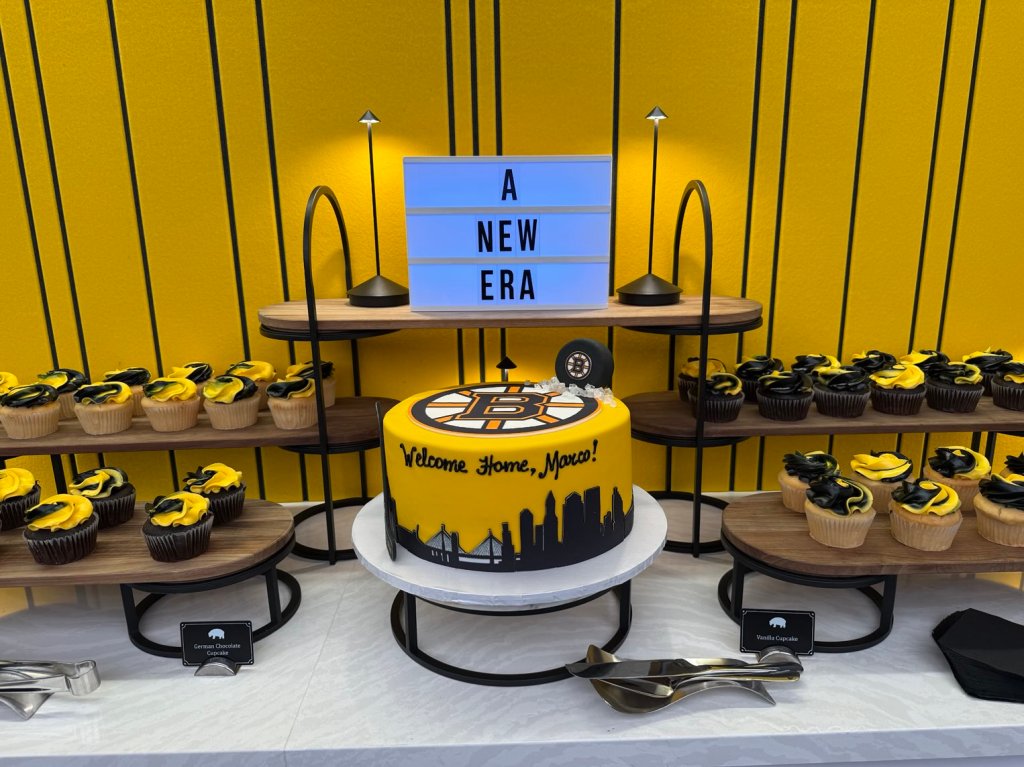
Photo “tweeted” by The Boston Globe’s Kevin Paul Dupont
“You know, it was not easy,” said Sturm, offering high praise for the Los Angeles Kings, particularly former Bruin Glen Murray and recently fired GM Rob Blake. “A lot of guys, a lot of people, don’t know I was by myself in (Los Angeles) for the last six years, and because I was chasing my dream, right? And without my family, I couldn’t have done it. Quick story, they’ve been bugging me for a while to get a place in Boston, right? They always wanted. They grew up here. My kids grew up here. They always wanted to come back, and here I am right now. They got their wish.”
Sturm also thanked Patrice Bergeron, who attended the festivities just to support his former Boston linemate. (It really would have been cool had Brad Boyes, the other winger on Bergeron’s first NHL line, made it just for the photo op. I digress.)
Among the many things that emerged from the Q&A with Sturm and General Manager Don Sweeney: a reality check issued by the new coach where it concerns style points. As in, the reason Paul Maurice’s Florida Panthers can play “all out” is GM Bill Zito has given him the players. “I don’t think we’re quite there,” said Sturm, who several times referenced the likelihood that the present roster that he made damn sure we understand is not chopped liver will be different come September.
This is predictable but important.
So much has been said and written continentally about the Bruins that willfully ignores Sweeney’s public statements that he intends for the team to make the playoffs next season and be as competitive as possible.
Realistically, legitimate Stanley Cup contention is probably three years off at best, but the widespread notion that this is a planned rebuild so why not get a young coach to go with the young team misses the point of Sturm’s hire.
Sweeney has said over and over again going back to March 7 that the reason the Bruins traded Brandon Carlo and Charlie Coyle, core players with term remaining on their contracts, was not to break down the roster for long-term reinvention but rather in the immediate.
Yes to the opportunity to recover some of the draft capital sacrificed at most of the last several trade deadlines for the sake of deep playoff runs that rarely materialized (2019).
The premise in this year’s strategy is to have their cake and eat it, too, as colleague Kevin Paul Dupont’s photo above displays. Sure, take home a black-and-gold cupcake, but I’d probably get my credential pulled had I stuck a finger into the bottom of that spoked B and taste-tested a gob of frosting. (I couldn’t get around the black frosting and smartly abstained altogether.)
What Sweeney intends as Part Two of his reinvention campaign is to be aggressive in the draft-weekend trade market and/or the free-agent signing period that begins on July 1.
By the way, my Bruins-fan friend Roger Towne often shares his thoughts on the team in sometimes, deep-diving emails. His most recent was more brief, but he shared a suggestion that explains why the Bruins would let Henri Jokiharju walk away in free agency: Dante Fabbro is also UFA.
I remember my colleague Kirk Luedeke’s enthusiasm over Fabbro’s prospects before the 2016 draft that, three picks earlier, sent his future Boston University teammate Charlie McAvoy, to the Bruins at 14th overall. Fabbro, the right-shot Canadian who has just reached UFA status at age 26 with Columbus, wound up becoming the sixth of eight defenseman chosen in the first 20 picks of the 2016 NHL Draft, going 17th to Nashville. Now run by Barry Trotz, the Predators are making changes and have moved on from Fabbro, who played out his contract with the Blue Jackets.
Despite his growing profile with Hockey Canada, Sweeney’s draft picks have been more American than anything else, and more European than Canadian. The Finnish Jokiharju, who turns 26 on June 17, was also a first-round pick and helped settle down Nikita Zadorov’s hyperactive game, so it had been assumed here the Bruins would be aggressive in keeping Jokiharju away from the open market. Crickets on that front.
Fabbro is a Canadian but from British Columbia, a long-favored region of Bruins’ amateur scouts.
The Ontario Hockey League still leads the way in sending players to the NHL, but the Bruins over the 21st century have treaded lightly in the OHL when it’s come to making picks in Rounds 1-3, Matt Poitras being a notable exception. It’s not the exaggerated issue it was in the several years between OHL Canadians Nick Boynton (Round 1 in 1999 at the FleetCenter) and Michael Hutchinson (Round 3 in 2008), but when it comes to asking questions about the Bruins’ drafting practices, Boston’s apparent allergy to OHL players has been of far greater interest to Rink Rap than, say, what happened in 2015. Bottom line, any time I’ve asked the question, the answer has always been the same: The Bruins are only focused on the one choice in front of them at the time of the pick, and the player’s origin or amateur league happens to be whatever it happens to be.
With major junior players newly eligible to play NCAA, this is sure to change the dynamics that exist (if they ever did exist). So there.
Sturm identified two influential coaches as a player, Darryl Sutter in San Jose and Claude Julien in Boston and one as a developing coach, Todd McLellan in L.A. In discussing Julien’s influence on the Bruins (after Sturm had spent two seasons in Boston prior to Julien’s arrival), Sturm said the following:
“You could see the process. You could see every year how we got better, and all of a sudden, I see a big change here in the city of Boston, because they’re behind you. And that feeling alone, it still feels like yesterday to me, and that’s exactly what I want to bring back. Forget about winning and losing. Yes, we have to win. I know that. But even when there were tough switches, you know tough games, you know that feeling, and hopefully the fans in the city of Boston will feel it every time they going to watch us play, we got to compete. We’re going to be structured, I can tell you that, but we also got to compete and make everyone proud.”
There will be a defensive foundation and a structured approach, but Sturm also discussed a more aggressive approach toward advancing the puck through the middle of the rink, indicating creative counter-attacks. He stressed that, especially with the roster in a developing stage, these implementations will not be realized overnight, but he is intent on beginning a process of getting to work on getting the Bruins to play the game at a faster tempo “as soon as possible.”
With longtime assistant coach/associate head coach/interim coach Joe Sacco off to New York where he will assist new Rangers – oops, gotta say it like a New Yorker – “Ranger” coach Mike Sullivan, Sturm will augment his existing staff of Chris Kelly, Jay Leach and Bob Essensa with a new hire whom he says will have experience running a powerplay.
To kick things off this morning, Sturm was presented a No. 30 Bruins game sweater, but it’s not in the same spirit that we quibble with this apparent mistake that we had with the long-awaited recognition of team captains missing from club records until more than a decade of cajoling was finally addressed in time for the centennial celebrations of 2023-24.
This week, longtime Bruins fan and Society of International Hockey Research frequently contributing member Ed Norris pointed out via this excerpt of a lengthier missive he shared via an email to his similarly nerdy friends: “If they don’t count Joe Sacco because he had the ‘interim’ tag, then they shouldn’t count Mike O’Connell who also had that tag during the 2002-03 season. The ‘Boston Bruins 2020-21 Guide and Record Book,’ which is the last one published, listed 28 head coaches, including O’Connell who coached nine regular-season games and another five in the playoffs. Jim Montgomery and Sacco
coached after the publication was released.”
Harry Sinden’s two stints as interim coach (1979-80 after firing Fred Creighton late in his first season and 1984-85 after firing Gerry Cheevers during his last of five years behind the Boston bench) are not part of Norris’ calculation because Sinden was Boston’s coach from 1966-67 through 69-70. So it’s not counting appointments but the people who have held the job.
Though I still like to date 1960s and 70s Bruins photos posted on the special Facebook pages I visit, I cringe at the thought of another accuracy issue when it comes to franchise history. Get Bill Cowley’s No. 10 up where it belongs, and I hereby pledge silence on all matters pertaining to franchise records.
 Rink Rap with Mick Colageo