With every passing decade, I’m less likely to predict a winner, but I’ve got a bad feeling for Boston Bruins fans. That draft pick that GM Don Sweeney acquired in the Brad Marchand trade is probably going to be a second-rounder after all.
I’ve never been sure if this is Toronto’s time – more on the Maple Leafs below – but history is not on the side of the Florida Panthers for tonight’s Game 7 (7:30 ET on TNT/tru/max in the U.S.).
Tonight, the Panthers are trying to get two-thirds of the way toward becoming the first team in 40 (forty) (!) years to play out three straight, full-length, National Hockey League seasons and cap all three of them off with a trip to the Stanley Cup final.
The last to do it was the 1984-85 Edmonton Oilers, considered by the NHL to be its greatest team ever.
Now regardless of how B.S. it was in the first place for the NHL to attempt to pull this “greatest ever” decision away from its benefactors (the fans) and create an official dogma (just as Commissioner Gary Bettman did in ruling that all NHL teams must retire No. 99), or the fact that those Oilers never won the championship (at least) three years in a row (something two other post-expansion teams did), the point of bringing it up here is a measure of contrast.
That Edmonton team had a young nucleus of Wayne Gretzky, Mark Messier, Jari Kurri, Paul Coffey, Glenn Anderson and Kevin Lowe and no salary cap. Moreover, those Oilers were so historically skilled that the hardnosed physicality and compete that it takes to win the Stanley Cup was present but not the primary aspect of their ability/strategy.
For grinding, physical, cap-era teams like the 2007 Ducks, 2011 Bruins, 2012/14 Kings, 2019 Blues, 2023 VGK’s and 2022-25 Florida Panthers, the physical toll on winning was extraordinary. It’s plainly less sustainable for teams that (via management/coaching/leadership/culture/methodology) turn hockey into a street fight to contend year in and year out.
Compound that challenge with 32 teams playing out a relevant regular season, something else the 84-85 Oilers did not have to endure. In their era, 16 out of 21 teams made the playoffs, allowing the dynastic Islanders and the dynastic Oilers who succeeded them to glide through their 80-game schedules, annually turning up the flame in March.
An aside on the Tampa Bay Lightning: Awarded the Cup in consecutive years but legitimately only in 2021 – I don’t care who it annoys, the 2020 bubble tournament had zero to do with the 2019-20 season – the Bolts’ greatest, cap-era achievement was playing a full 2021-22 season and grinding through impactful injuries all the way to a Game 6 against the eventual champion Avalanche.
Officially, the Lightning made three straight Cup finals but only because the NHL (and the complicit NHLPA) held a 2020, made-for-TV, warm-up tournament and put the league title on the line, cheapening the legacy of team sports’ greatest trophy.
To be clear, no disrespect to the Lightning. Every other team called back from early summer vacation competed, including the Presidents Trophy-winning Bruins. The fact is the Lightning would not have had Victor Hedman in their lineup had Covid not put a full offseason between the 2019-20 schedule and the so-called 2020 playoffs. I do not align with those who criticize Tampa Bay for hiding Nikita Kucherov on LTIR before bringing him back to lead the way to the 2021 championship following the shortened regular-season schedule. Tampa was the best team in the league, hands down.
The point is that what the Lightning accomplished was physically and categorically nowhere near what the Penguins did in winning a second straight championship in 2017 or what the Panthers are trying to accomplish this spring.
What history is asking of the Florida Panthers is not realistic.
The closest the cap era (2005-06 to present) has come to a threepeat is when the Chicago Blackhawks were in Game 7 overtime of the 2014 Western Conference final against the Los Angeles Kings (Chicago had won in 2013 and would again in 2015). Along with Pittsburgh, the Hawks, with three championships in a six-year stretch, stand as the co-legacy team of the era.
As for the Toronto Maple Leafs, they are the Boston Red Sox before 2004 – unless it is finally 2004.
For the Washington Capitals, by regular-season measure only the best team of the first dozen years of the salary-cap era, to finally win in 2018, they needed the good fortune for a second-round opponent to be a team that was trying to make history as the era’s only two-time defending champion going for a threepeat. On their own end of the equation, the Caps finally became eligible for the pursuit upon center Evgeny Kuznetsov’s overdue emergence as a postseason impact player. They were finally ready to vanquish their nemesis, the Crosby-Malkin Pittsburgh Penguins, obviously weakened and ripe for defeat.
How much more difficult for the Panthers to accomplish what the second-time-around Penguins could not, especially with the way Florida plays hockey?
Tonight, the Leafs are playing the role of the 2018 Capitals, ever long on potential and seemingly destined to break their fans’ hearts as the annual appointment in a ritual so torturous it has drawn third-party attention like a traffic jam of rubberneckers who can’t help but watch the faces in the sea of blue watching outside Scotiabank Arena on the big screen. All of this will only sweeten the moment that awaits the Leafs and their lifers should they engage their destiny tonight and end Florida’s reign of terror.
As well deserved as it will be for Leafs Nation, winning arrives with a familiar measure of circumstantial compliance.
Winning will not be a referendum on the Panthers anymore than any other outcome in sports history. Very rarely do two great teams ever clash at the height of their powers, drive, energy, health, etc. There is always a story and a backstory and asterisks.
Philadelphia fans will go to their graves believing that coach Freddy “The Fog” Shero solved Bobby Orr; Bruins fans old enough know Orr’s left knee was ravaged by too many invasive surgeries for him to be the same skater he had been in 1972, and that the 1974 Bruins were nowhere near the team they had been before being pillaged by the simultaneous World Hockey Association and NHL expansion. (Because the New York Rangers would lose so quietly in the 1973 Cup semifinal to Chicago, the Blueshirts’ opening-round, five-game romp over the banged-up Bruins is widely forgotten.)
Fans who hated those ’70s Flyers think of the 1975-76 Montreal Canadiens as the team with the most important of all playoff wins, a victory for the game of hockey over thuggery, but Philly fans know their team did not have Bernie Parent, the Conn Smythe Trophy winner of 1974 and ’75, nor did they have playmaker extraordinaire Rick MacLeish, arguably the second-best second-line center in the game.
The Broad Street Bullies will reappear in this discussion with MacLeish front and center (no pun intended).
Through decades of hockey obsession, I’ve become less and less interested in making predictions and more and more interested in identifying essential characteristics of potential champions. I can’t tell you who will win, but years have told me which teams cannot and which teams are built on incomplete or fatally flawed foundations.
Two primary blueprints have emerged upon which NHL GM’s have filled out the rosters pounded into the barrel of the Stanley Cup: One is based on two elite centermen (either could effectively center the top line on any team in the NHL), the other on a big-three defense (big-name goaltender optional).
You have to have one or the other to win. A rare hybrid might have functional elements of both models but with all-time greats in each position: The 1970 Boston Bruins (Bobby Orr and Phil Esposito) and the 2008 Detroit Red Wings (Nicklas Lidstrom and Pavel Datsyuk) would qualify as hybrids, but it could also be argued that the Red Wings had altered their model from the two-center (Steve Yzerman and Sergei Federov) to the Big 3 D (a prime Lidstrom, a young Nikolas Kronwall and a journeyman Brian Rafalski, with a very strong No. 4 in Brad Stuart). The Wings were similarly complemented up front by hybrid forward Henrik Zetterberg. The Bruins also had high-level, complementary players in defensemen Dallas Smith and Don Awrey, center Fred Stanfield and one of the top three wingers of his era, John Bucyk.
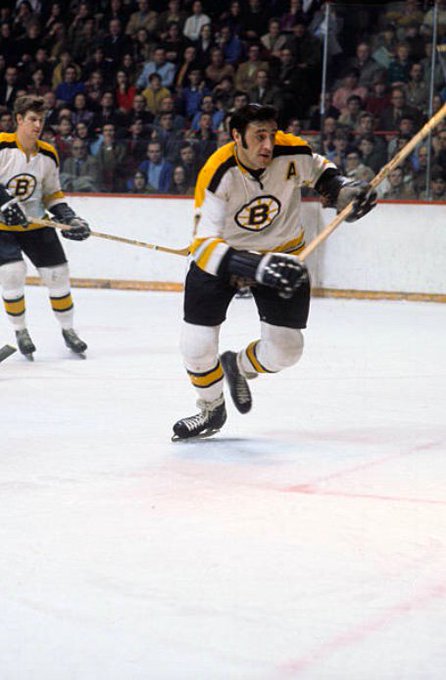
Bobby Orr, left, and Phil Esposito were so historically impactful that the 1967-75 Bruins were arguably unique in their championship roster construction.
What about goaltending (I hear the reader protest)?
Goaltending has to be solid and it has to be clutch, but a superstar netminder is not a prerequisite to winning the Stanley Cup.
It takes a village, a goalie (or two – see Boston 1972), a coach, lots of team chemistry, general good health and puck-luck to ultimately come out on top, and thusly an essential architecture or foundation of roster construction can easily get lost.
But it’s always there for the team that wins it all. Nobody, without one or the other, catches fire for two months and drinks from the Cup. No. Buddy.
Before we call it a day at Rink Rap, a quick look at cap-era Cup champs.
Two No. 1 centers:
Carolina 2006: Eric Staal and Rod Brind’Amour
Pittsburgh 2009, 2016, 2017: Sidney Crosby and Evgeni Malkin
Boston 2011: David Krejci and Patrice Bergeron
Los Angeles 2012 and 2014: Anze Kopitar and Mike Richards/Jeff Carter
Washington 2018: Nicklas Backstrom and Evgeny Kuznetsov
Florida 2024: Aleksander Barkov and Sam Bennett
Big 3 D:
Anaheim 2007: Chris Pronger, Scott Niedermayer, Francois Beauchemin
Detroit 2008: Lidstrom, Kronwall, Rafalski
Chicago 2010, 2013 & 2015: Duncan Keith, Niklas Hjalmarsson and Brent Seabrook
St. Louis 2019: Alex Pietrangelo, Colton Parayko and Jay Bouwmeester
Tampa Bay 2021: Hedman, Ryan McDonagh and Mikhail Sergachev
Hybrid:
Colorado 2022: Nathan MacKinnon and Nazem Kadri at center; and Cale Makar, Devon Toews and three other defensemen with equal ice time (Bowen Byram, Josh Manson & Erik Johnson)
Las Vegas 2023: Jack Eichel and Chandler Stephenson at center; and Pietrangelo, Shea Theodore and three other defensemen with equal ice time (Alec Martinez, Brayden McNabb, Zach Whitecloud & Nicolas Hague)
Note: All hybrids feature at least one center and one defenseman of historic impact/ability.
A bit more on the Philadelphia Flyers and the significance of Rick MacLeish:
Originally property of the Boston Bruins, MacLeish was traded in May 1970 to Philadelphia for center-wing Mike Walton, who played meaningful regular-season hockey for the Bruins in 1971-72, especially when top-line RW Ken Hodge was injured. Hodge was a beast in the ’72 playoffs, and there is no doubt here that the Bruins would have won in ’72 without Walton.
There is also no doubt here that MacLeish completed the Flyers’ foundation for Cup contention, his finesse game perfectly complementing what Bobby Clarke brought to Philly’s top line. That regretful transaction changed the decade, as the Bruins would have won the Cup again in the mid ’70s had MacLeish been on their side. If Walton were to elevate his game, it didn’t help Boston that an off-ice incident precipitated Walton’s 1973 jump to the WHA; when the Bruins and Flyers clashed in the ’74 Cup final, Walton was long gone. Late in Game 2 with the Bruins up by a goal, Orr had MacLeish pinned to the LW corner, the puck in their skates. Esposito and Hodge swooped through the circle looking to gobble up a loose puck and shoot for the empty net, but MacLeish deftly waited for the perfect moment and finessed a pass to the slot for an onrushing Andre “Moose” Dupont, whose one-timer beat Gilles Gilbert and set off the goal scorer’s trademark, running-in-place celebration. The game infamously was won by Clarke in overtime. Without MacLeish in ’76, the Flyers didn’t have the ability to match up against a deep, defense-first, Montreal team. Rink Rap was among those who took some satisfaction in seeing the Flyers knocked off their pedestal and even more so in ’77 when the reinvented, post-Orr/Espo Bruins swept them out of the semifinal, but the Flyers were a great hockey team that, amidst their legacy of goonery, never get their proper due.
The Florida Panthers are a modern-day version of those Flyers, both in roster construction and in culture. We could easily write the New Jersey Devils into this script, at least from a cultural standpoint.
If they lose tonight, it’s not the end of their kind of hockey – it will always take enormous grit and aggression to win – nor is it the end for their winning window. That said, going three full-length seasons all the way to the Cup final is not only unprecedented in the salary-cap era of parity at the top where up to six teams on average have a legitimate shot at the Stanley Cup but hasn’t happened since the greatest offensive machine of the NHL’s modern era was blossoming in a non-cap world.
History says not this year.
Whether or not the Maple Leafs prove to be the 2004 Red Sox is another question.
My gut says Dallas, and the reason is Miro Heiskanen is back, allowing the Stars to thrive on their intended Big 3-D foundation with Esa Lindell and Thomas Harley. They already check so many other boxes.
The Edmonton Oilers (Connor McDavid and Leon Draisaitl) are a two-top-centers team even if Draisaitl goes to McDavid’s line and Ryan Nugent-Hopkins centers the second line, but the Stanley Cup hangover is also tough on the team that went to the last minute of the last game and lost. The Oilers are eligible. Of that there is no doubt.
I like Carolina in the Eastern Conference, mainly because they fly so comfortably under the radar and play their game without fanfare beyond their loyalists. If, as I anticipate, the Panthers fall out of the 2025 picture, then the Hurricanes become the team that is most scary in that they exceed the sum of their parts. (It also helps that Andrei Svechnikov is enjoying a breakout postseason.) They’re a Big-3-D team precariously built around Jaccob Slavin with Brent Burns and Dmitry Orlov.
There is no team remaining that is fatally flawed, unless Burns’ age (40) catches up with him on the postseason backstretch. In that case, Jalen Chatfield will have to return to the lineup and further elevate his game.
What about Toronto?
Even if the shine has worn off John Tavares these past several, post-NYI seasons, he still has hard, offensive skills that have led to 5 postseason goals. Auston Matthews is underperforming offensively but has just scored the biggest goal of his career. It doesn’t necessarily need to lead to many more to get the Maple Leafs to the winner’s circle. Remember when Ken Hitchcock turned the great Mike Modano into a shutdown center for the Peter Forsberg matchup en route to the 1999 Stanley Cup championship.
The Maple Leafs have added key, complementary pieces to their lineup, including Oliver Ekman-Larsson and Steven Lorentz (Florida), Brandon Carlo (Boston) and Scott Laughton (Philadelphia). More importantly, Toronto’s top players are positively affected in their own embrace of this battle of will against the Panthers.
Again, not predicting as much as anticipating an outcome here when I admit it reminds me of Game 1 of the 1984 Stanley Cup in which the historically explosive Oilers won 1-0 at Nassau Coliseum, ensuring a series split before the series shifted to Edmonton where the Oilers, full of confidence, made the Islanders look as battle torn as they were, having become the only entirely post-expansion team to make five consecutive Cup finals.
What Bruins fans are asking Marchand, an iffy Matthew Tkachuk and the Panthers to do is not historically realistic. A week ago, it may have looked like a shoo-in, but the wall of history is formidable and it rises in its own time.
Over and out for now.
Enjoy the game, and happy hockey to all.
 Rink Rap with Mick Colageo