I’m frankly happy I got this question out of my way on September 30, and I don’t blame Boston Bruins General Manager Don Sweeney or pending unrestricted free agent Trent Frederic one bit for being any less than eager while addressing it with trademark professionalism.
Imagine how little conversation this matter can get now that hockey’s most popular podcast has made Frederic a featured topic of discussion.
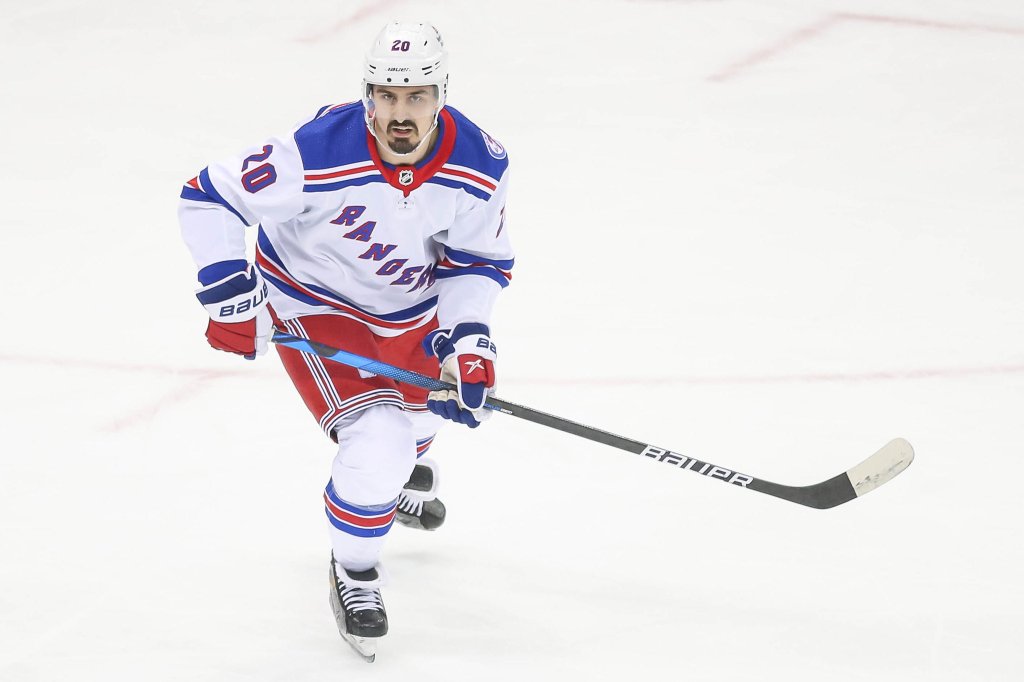
Rangers winger Chris Kreider was made a healthy scratch for Monday’s game in New Jersey.
If you missed it last week, Elliotte Friedman reported during an episode of “32 Thoughts: The Podcast” that several NHL teams are interested to learn the Bruins’ intentions where it concerns Frederic, who has the right to go to the open market as an unrestricted free agent on July 1, 2025.
From inside the headaches of a 2024-25 Bruins season that obviously did not start well and a roster that has already been theoretically deconstructed by a vocal segment of a frustrated fanbase given to I’m done with this guy and I’m done with that guy, it’s easy to overlook how coveted this player is across the league.
A St. Louis product contemporary to the Tkachuk brothers, Frederic is also big (6-foot-3, 220 pounds) and rugged. On the cusp of age 27 (Feb. 11, 2025), his quiet stat line (5-6-11 in 14:05 average time on ice over 35 games) has been part of the story behind the Bruins’ offensive slog. And his contract crossroads arrives right at a time when Bruins management must formulate a long-term outlook on this player’s career.
Although Frederic’s goal production under Interim Coach Joe Sacco has been limited to two against Philadelphia on Dec. 7, his minus-13 for the season is largely based on a horrendous start in which he went minus-7 over the Bruins’ first four games. He played minus-11 hockey before the coaching change and has played minus-2 hockey since, the recent negatives driven by the team’s twin, third-period collapses in Winnipeg and Seattle.
Except for those lopsided losses, Frederic is back to being a reliable, two-way forward whose game ebbs and flows with that of his team.
When a team drafts this kind of player, going for late-first-round qualities, it demands the package include a strong sense of citizenship and the highest value placed on the team concept. Lastly, it hopes for that special intangible, the ability to rally one’s teammates.
Captain Brad Marchand (a third-round pick in 2006) is the gold, box-checking standard for the franchise, and the Bruins have long been grooming Frederic toward the kind of next-generation leadership it requires to endure the battle level at the top of the NHL and engage the fanbase.
Frederic has given Boston fans a popular highlight that reappears frequently on the TD Garden videoboard in which he steps up when a teammate is challenged during a road game, then wins the fight.
Following a more recent encounter, he was asked to explain himself after he injured Winnipeg forward David Gustavsson, who it turns out had never fought before Frederic cleaned his clock. Gustavsson needed assistance and entered concussion protocol but returned to the Jets’ lineup on Saturday.
The immediate result was two more fights that more-adept members of the Jets initiated with commensurate combatants Mark Kastelic and Nikita Zadorov.
After the game, Frederic engaged reporters as well, explaining his side of it and discussed the many times he would find himself in AHL battles with ECHL recalls looking to get a future NHLer on their resumes. He’d fight them and find these things out afterwards, just like he hadn’t a clue on Gustavsson’s lack of such a resume. Frederic reportedly didn’t care for how the winger lined up for the faceoff after Winnipeg’s sixth goal. Their engagement was apparently mutual and in the moment; it turned out to be a massive mismatch.
Though Frederic was drafted as a future, middle-of-the-lineup center very much in the role that Charlie Coyle has held down with aplomb since being acquired at the 2019 trade deadline in a deal with the Minnesota Wild for disgruntled prospect Ryan Donato, his role had been gravitating toward wing almost exclusively until Saturday night’s game against Buffalo when Frederic was deployed at center. The move involved Coyle shifting to right wing in the top six. Game-day reports have both in their new positions again tonight against Washington (7 pm, NESN, 98.5).
Former Bruins coach Jim Montgomery (now coaching the Blues) openly considered Frederic a winger. When asked Saturday by attending reporters, Sacco talked about hockey issues including Coyle and referenced a shorter experiment during the Bruins’ recent comeback victory in Calgary.
What Sacco cannot divulge is what else may be at play, such as management honoring a request by a potential trade partner.
If the Bruins have decided, for instance, that they will not be successful in reaching an agreement on a contract extension for Frederic, then trading him sooner rather than later to get more scoring into their lineup would make sense.
There is yet more noise to blow below, but this is an appropriate time to revisit what we have actually been told on the Freddy Front.
When the executive branch of the Boston Bruins was looking to wrap up its September 30 preseason press conference at TD Garden (the same event in which team president Cam Neely had just blurted out “64 million reasons” why he’d be in training camp), yours truly got the last question. Noting that Frederic is UFA at the end of the season, I asked Sweeney if there are plans to ignite an extension for him.
Despite what had just happened in that presser – remember, the serendipitous result of Neely’s comment on Jeremy Swayman’s holdout was not yet realized – the GM assured the gathered media that conversations were already underway regarding extensions for Frederic and RFA forward Morgan Geekie.
After practice that day, I approached Frederic while the media hoard was preoccupied across the room, seeking to confirm his side of the situation. After confessing my baggage – St. Louis boy, most certainly coveted by his hometown Blues – I said, “You want to be here, right?”
“Yeah, I do,” said Frederic. “I’ve had conversations with ‘Sweens,’ expressed how much I want to be here. I think it’s just a matter of time, hopefully, where we get something done. I told him that I want to be a lifelong Bruin, I want to play here. The city’s been great.”
After he scored 18 goals last season and returned in line for an increase above his 2023-24 ATOI of 13:45, Frederic’s 2024-25 season was not anticipated with the same cloud of doubt that Jake DeBrusk entered his (2023-24) contract year.
Historically, the Bruins extend players they want to keep long term before they enter contract years, but DeBrusk and the team could not agree on terms, and he wound up going to market. The Bruins allocated the cap space that it would have required to re-sign DeBrusk (plus $2.25M per) and targeted centerman Elias Lindholm, addressing the hole left by the 2023 retirements of Patrice Bergeron and David Krejci.
While from a technical standpoint the Bruins can afford to let Frederic walk, it would not be as advisable. Replacing his intangibles is an arduous study, and buckshot attempts at tangibly comparable mercenaries rarely work out.
DeBrusk’s case was a little like Torey Krug’s in that here was a player who had earned a cap allocation the Bruins could not afford given said player’s limitations. In Krug’s case, it was about defensive matchups, in DeBrusk’s it was about consistent game engagement. While he played in multiple roles including special teams, he could disappear for 15 games at a time, and we’re not confining that observation to the scoresheet.
There are players who try to impact the game in select moments and those who play through it as a central cog in the gearwork of the sport. Patrice Bergeron was the epitome of the latter. Bobby Ryan was a good example of the former. You don’t notice him except for that moment he’s making the difference in what would otherwise be a stalemate of a hockey game. Some players are good enough to convince their teams that they should be valued in the same category as those whose heartbeats set the course of the entire game. The Bruins determined that DeBrusk is not at that elite level and let him go rather than pay core-player money.
Sometimes, it’s less about the player and more about what a team needs, and given the position the Bruins were in when DeBrusk’s contract came up, it’s understandable if they wish they could have kept him but absolutely needed to fortify their strength down the middle (so help me Harry Sinden).
Prioritizing the center position is the same theory espoused by Hockey Canada for international play, and Sweeney is the country’s GM for the 4 Nations tournament coming soon to Montreal and Boston.
The Bruins chose to retain DeBrusk at the 2024 trade deadline on the premise that he would function as their deadline rental, and it worked as DeBrusk led Boston in the playoffs in goals (5) and points (11).
Frederic is not expected to similarly impact the offense, and since his value around the league is at an all-time high because of what he does provide, Sweeney is in a position to consider some tempting options, even if letting Frederic go takes a bite out of a gritty side of the apple he has worked so diligently to farm up.
One reason Frederic’s extension never got done might be the same as Montgomery’s.
Frederic was far from alone in his perplexing start. Several returning players including Coyle, Geekie and David Pastrnak also began the season out of synch with themselves and each other, and the resultant urgency brought about by this collective funk eclipsed all long-view thinking on management’s end while individual players and the team ironed out their on-ice deficiencies.
Some of that progress was underway when Hampus Lindholm went down blocking a shot, and whatever forward progress Montgomery was able to realize went poof. Unable to outrun his team’s recurring problems, he was fired after 20 games (8-9-3). The Bruins are 10-4-1 under Sacco, so the new coach is only five games away from the sample size it took to influence a change behind the bench.
To reach the schedule’s halfway mark, the Bruins will face a lot of red, white and blue: tonight at home vs. the Washington Capitals (whose .727 points percentage leads the NHL); a home-and-home with Columbus; a New Year’s Eve matinee at Washington; and two more road games vs. the N.Y. Rangers and the Toronto Maple Leafs.
If Bruins management doesn’t know how it feels about this roster after 15 games coached by Sacco, then it certainly will after 21.
Philosophical Decisions
Sweeney acquired Coyle with a 2-for-1 mindset. He arrived as a centerman who could play right wing as needed. Remember, the Bruins still had David Backes, a more accomplished player in a similar, multi-purpose role, albeit at the tail end of his career. The Coyle acquisition was hailed as a coup, especially considering he hails from Boston (Weymouth, Mass.) and even played at Boston University. It’s been quite some time since Coyle has been deployed to RW.
What should we make of his move to the wing, especially in the post-Bergeron/Krejci era?
It would be naïve not to consider several possibilities including one that could affect Coyle. Consider Matt Poitras’ recent scoring surge in AHL Providence. A team that needs some pop to ease some of this regular-season grind so reminiscent of 2009-10 is reaching a crossroads where it concerns its abundance of middle-lineup centermen.
Are the Bruins, after all this time, really reconsidering Frederic as a center on the premise that Coyle could complete its top six on right wing? Plausible but doubtful.
Desperate for greater influence of his second and third efforts and structured yet intense play, it was Montgomery who moved Pavel Zacha (his best forward before the ax fell) back to center where he had played most of last season. That decision leveraged Poitras to the minors, where he has thrived since adjusting to the AHL’s quirks. David Krejci played an entire AHL season at roughly the same age, so Poitras playing heavy minutes and in all situations can only help him in the longer run.
Meantime, the mandate from ownership to make the playoffs was twice verified. The first year that Mike O’Connell and Peter Chiarelli failed to qualify for the postseason were the last of their tenures as Bruins GM.
As an aside, let’s put this to bed once and for all: If you’ve followed Sweeney’s career as a player, seen the many hits he’s taken to make the right play as a defenseman, enduring a year of Mike Keenan, or the due diligence with which he has consistently scoured the circuits in an effort to keep the Bruins in Cup-contention mode, it is the absolute, most ludicrous suggestion anyone could make that this guy, who has been shunning shortcuts on behalf of the Boston Bruins since turning pro in 1988, right under our eyes for almost all of it (2003-04 Dallas Stars), would manage for his job.
Not having it, not a bit, not hearing anyone out on it. Get lost.
I digress.
As long as the Bruins can continue their path toward solidifying a top-three position in the Atlantic Division, then the longer management can afford to let Poitras develop his game in the AHL.
While monitoring the season and potentially waiting until the home stretch to recall Poitras remains a preferable scenario, the sophomore center’s return would still be categorized as an internal solution and would necessarily precede a major trade. However, just as the pivot of Zacha back to center leveraged Poitras to Providence, his return to the NHL roster would link up with a trade of a roster player for a right winger who can score a few goals and presumably turn some of these 2-1 games into 3-1 games before opposing goaltenders vacate their nets for an extra attacker.
Though the struggling New York Rangers have met with GM Chris Drury and are trying to move on from the infamous memo that sent his 12-7-1 team into a 4-9-0 funk and right out of the Eastern Conference playoff eight, one wonders if there is any going back on what amounted to an auctioneer’s call for an opening bid on Chris Kreider.
So far, Jacob Trouba and Kaapo Kakko have been traded, so we know Drury wasn’t blowing smoke.
Boston’s inevitable logjam at center and their need for a finisher/powerplay producer give off a very Coyle-for-Kreider kind of vibe.
Consider the fit:
Historically, the Rangers like New England and NCAA-developed products as much as the Bruins do, and neither would lose those influences in a Coyle-for-Kreider swap. Their ages (Coyle will turn 33 on March 2, and Kreider will be 34 on April 30), size (Coyle goes 6-3, 218, Kreider 6-3, 230) and salaries (Coyle has one more year on a six-year deal with a $5.25 million cap hit – an 8-team no-trade list kicked in this season; Kreider has two more years on a seven-year deal with a $6.5 million cap hit – a 15-team no-trade list kicked in this season) are exchangeable with tweaks.
The imbalance is in career production, where Kreider was a 50-goal scorer as recently as 2021-22, following that up with two seasons flirting with but not reaching 40. So, to equate the cap-space and game-sheet impact, the Bruins would presumably need to augment their end of the deal.
Coyle scored a career-high 25 goals as Boston’s top center last season and has always generated more assists than goals; counting the playoffs, Kreider has 86 more goals than assists. As the Bruins’ leader without the letter, Coyle has been a three-zone, puck-protecting stalwart, and his goal on Saturday night against Buffalo serves as a reminder that he’s still got game.
Good trades hurt, and this is a potential one that I cannot unsee, at least for now.
Per Steve Conroy (Boston Herald), Coyle was once again on Elias Lindholm’s RW at the morning skate for tonight’s tilt vs. the Caps, and Kreider was a healthy scratch for today’s Rangers-Devils matinee in New Jersey.
Nothing, of course, can officially happen now that the NHL has entered its Dec. 20-27 holiday roster freeze, but one has to wonder if Kreider has played his final game as a Ranger.
Meantime, Bruins management deliberates on Frederic.
Losing both Frederic and Coyle would take a huge bite out of the fabric of Boston’s lineup. To move on from Coyle, management must believe that sooner rather than later Poitras will sustain NHL-level performance as a second or third-line centerman, and they must be satisfied with the compensation should the seven years they’ve spent developing Frederic be realized in his prime years in another uniform (cue up the outrage Chicago fans felt over Phil Esposito, Boston fans over Al Secord and later Joe Thornton, Vancouver fans over Cam Neely … do I hear a vote for Jeremy Lauzon?).
The one piece of advice Sinden said he gave O’Connell when the latter was negotiating with San Jose was that, if you think this is the right move for your hockey team, then you have to do it.
It’s no wonder NHL management teams conduct thorough evaluations including other teams’ players via extensive pro scouting, all the while internally exploring all options very carefully before taking the plunge.
I remember how hard I found it to believe that Sinden would trade Gregg Sheppard (for defenseman Dick Redmond), but the emergence of Peter McNab and Bobby Miller made it a practical maneuver.
Lest I be misunderstood, this is not a pitch for a Coyle-for-Kreider swap or a Frederic trade. The fan in me would rather find a more subtle solution for a goal-scoring winger and keep the soul of this team intact. Only it’s getting more and more difficult to look up at the black sky and not see the gold constellation.
The stars are aligning, and while Sweeney is among the diligent GM’s in sports who is looking at things I would miss – if Mark Kastelic doesn’t win the 7th Player Award this season, the voters need a new optometrist – we all saw Elias Lindholm.
Mutual need, mutual fit, box-checking galore, it all hangs there in one place like a mistletoe in a Hallmark movie. Unless, of course, Drury is focusing more on Frederic, still a hockey trade but more of a salary mismatch.
Whatever is in store, it is painful watching fan favorites change uniforms, but you can’t let it cloud your judgment as an armchair GM.
As the great Cap Raeder (a career 1-0 as a head coach in the NHL, former Needham High, UNH, WHA Whalers and Team USA goalie, and longtime assistant, goalie coach and GM sounding board) use to admonish me in the press box while pro-scouting AHL and NHL games, “Don’t fall in love with your players. I’ve seen a lot of guys get into trouble that way. Don’t fall in love with your players! That’s all I’m saying.”
Too late, even for some sportswriters.
 Rink Rap with Mick Colageo