Having shaken out a troubling start via the National Hockey League’s first coaching change of the 2024-25 season and coincidental progress on the part of several returning players whose individual games had been in various states of disrepair – this extended far beyond Brad Marchand’s recovery from three summer surgeries and Jeremy Swayman’s contract negotiations to several other, more puzzling sets of skates hanging above familiar nameplates in the dressing room – the 15-11-3 Boston Bruins are finally in a place where management has a fair chance to figure some things out as they begin a five-game road trip in Winnipeg (8 pm ET, NESN, 98.5 The Sports Hub).
To wit: Was the brain trust right to project this team, with the addition of an established, all-purpose, two-way, three-zone, minute-munching centerman, a menacing but maturing left-shot presence on the blue line and fourth-line revisions accenting a forecheck that causes opposing defensemen anxiety on puck retrievals, as the Stanley Cup contender that last season’s Bruins almost were without these elements?
The question, of course, assumes that goaltending with a journeyman (Joonas Korpisalo) backing up Swayman (instead of the latter sharing the nets 41-41 with Linus Ullmark) would not significantly impact the equation.
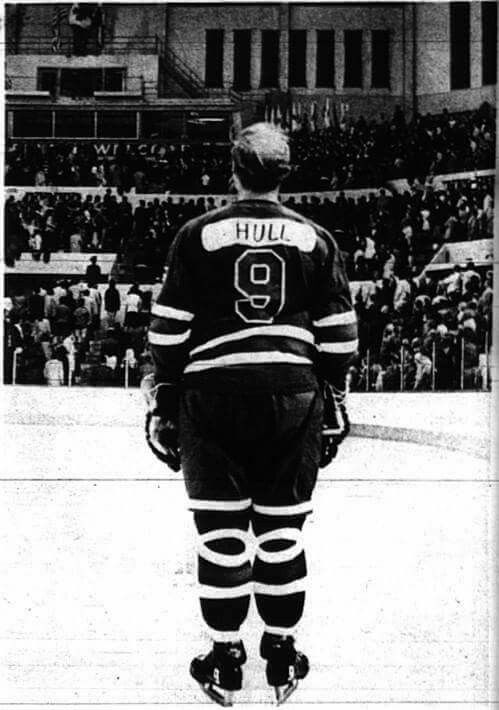
A year before the Philadelphia Flyers used home nametags (black letters against a white background) on their 1972-73 set of orange-away sweaters to appease NBC’s request for nametags during its 1973-74 Game of the Week telecasts in the U.S., the original Winnipeg Jets did something oddly similar but without any prior-season reason. Today’s Jets, of course, are the offspring of the Atlanta Thrashers.
That acknowledged, these impactful offseason personnel changes were impossible to evaluate amidst an opening 20-game segment so strange that conspiracy theorists playing Monday morning QB upon Jim Montgomery’s fifth-day introduction as the new coach in St. Louis have interpolated ideas about offseason tampering by the Blues, citing Monty’s dissatisfaction with the reported three-year term being offered by the Bruins in the way of a contract extension, suggesting that the Bruins didn’t really want him and that Monty’s heart was west of the Mississippi. And, of course, the Bruins quitting on Monty before the puck even dropped as a result.
I know some of the stars align beautifully to support the notion that something was brewing with the Blues. Here is my problem, especially with that last part (which is essential to the theory).
Let’s just say you’re Morgan Geekie and you are one year into your second chance at a NHL career after your former team, the Seattle Kraken, dished out the ultimate insult by choosing not to offer you a qualifying contract to retain your Group 2 restricted free agency rights. Things go incredibly well in Boston over 2023-24, where by season’s end the management and coaching staff (led by Montgomery) believes so strongly in you that, when it became apparent that Pavel Zacha was running out of steam as a center in the top six and the take-no-prisoners Panthers were the playoff opponent, they chose you to stand in between their winger-centric talent, entrusting you with the responsibility to win faceoffs, match up against the likes of Sasha Barkov or Sam Bennett, go the net against their nasty defensemen and give the Boston Bruins their best chance to win. Are you going to risk your career by becoming part of a quitting conspiracy? On the coach who thusly deployed you?
Let’s just say you’re Trent Frederic and you are entering a contract year with the leverage of unrestricted free agency on July 1, 2025. Things did not always go well for you when Bruce Cassidy was coach, but they have under Montgomery. Are you throwing your 26-year-old hat into such a ring?
I have my own theory on Geekie and Frederic, somewhat confirmed by Montgomery, whom I asked before the season if he identified those two forwards as players he did not need to situate with the same urgency as others because they’ve have been so good at filling in where needed that they can act as insurance policies for the number of things bound to go wrong in the lineup such as injuries, and he did not hesitate to agree with my line of thought on this.
As it turned out, both forwards started the season looking like homeowners about to install a major appliance but could not find the manual that they thought for sure was in the box when they opened it. They stood around, scratching their heads, not sure which foot to move forward first.
As a 90-something golf pro once told me, “when you think, you stink.” There is an element to hockey where it’s better to just play rather than be preoccupied with figuring out the details of your assignment.
Both players got better over time while Monty was still coaching the team. Geekie was further behind but made more rapid progress. Frederic … well you’re never sure he has found the soul of his game in a manner that inspires the kind of confidence that makes you forget that he goes through these things, but it was awfully nice to see him have a two-goal game last week against Philadelphia.
Frederic has only remained a concern because of his pending UFA status and the strong suspicion that the Blues salivate for the hometown kid as much as they apparently did for Montgomery. In answer to my question during management’s preseason presser, Bruins General Manager Don Sweeney did acknowledge that he was in communication with Frederic’s representative on a contract extension.
It was good to hear because the Bruins need more players like Frederic, not fewer.
I digress, but by highlighting the plights of Geekie and Frederic I hope to illustrate that the stories behind all of the subpar hockey played by various and surprising members of the Bruins over the first 20 games came in diverse packaging and, on each player’s own schedule, has seen examples of resolution, progress and traction. Dare we suggest momentum? Same for a much more established NHL player, Charlie Coyle, who seems to be back to doing Charlie Coyle stuff on a consistent basis.
When management did not pull the trigger on the coaching change after the Halloween debacle in Raleigh (an 8-2 loss, making it a 1-4-1 stretch to end the opening month), the Bruins responded with a pair of weekend shutout wins and went 4-1-1 over their next six. But when Hampus Lindholm blocked that shot in the comeback win at St. Louis and was lost on a week-to-week basis, it seemed the emerging sense of momentum went right out of the lineup with him.
The Bruins began springing leaks where it seemed they had found solutions. One game the powerplay is a disaster, next game they can’t kill a penalty to save their lives. Hampus Lindholm had easily been Boston’s best blueliner to that point, but they shouldn’t have been so rudderless without him. It became evident that Montgomery was not going to be able to outrun his team’s problems.
Nonetheless, when social media was suddenly populated with stories behind the story of Montgomery’s firing/hiring, the kneejerk reaction here was “really?” While some of the stars align, more than the emerging constellation was Monty’s line, “once a Blue, always a Blue.” I took that as a shot at the Bruins, who liked to say the same when feting former players, especially at the Centennial events completed with the 100th anniversary game on Dec. 1 against Montreal.
Here’s the part I can get on board with: Monty to St. Louis so quickly makes sense when reviewing prior occasions when general managers, coveting other teams’ coaches, fired good ones to hire the one they always wanted when that special someone suddenly became available.
Harry Sinden did exactly this in 1992 after Rick Bowness had taken a Bruins roster that, amidst labor strife, was in decline and over the course of the 91-92 season used 55 players and surrendered more goals than it scored (270-275) but, boosted late in the season by post-Olympic injections Joey Juneau, Ted Donato and Steve Heinze (and junior recall Glen Murray) opened their eyes like Bob Barker in that famous golf-course fight with Happy Gilmore. Only the Bruins were going to make the comeback.
A rookie coach handed this chaos when Mike Milbury was kicked upstairs to become Sinden’s apprentice, Bowness won two rounds, sweeping the Canadiens with a team that had spent a good chunk of the season soul searching. Yet, here they were, revising (Craig Janney and Stephane Quintal to St. Louis for Adam Oates) and surprising, making their fourth conference final in five seasons and doubling down on being Montreal’s daddy.
They survived a seven-game series against Buffalo when Pat Lafontaine was at his best, then swept the hated Habs before getting swept in the Eastern Conference Final by defending champion Pittsburgh (which wouldn’t lose a game to Chicago in the Cup Final either).
It was the only stretch of the teams’ historic rivalry in which the Bruins dominated their arch rivals (winning five of six playoff series over a seven-year period from 1988 to 1994 inclusive), and this time they did it without Cam Neely, who was limited by his 1991 playoff injuries to nine, regular-season games (9 goals, 3 assists). Without Neely, what happened seemed impossible.
Yet Sinden fired Bowness to hire Brian Sutter because he loved how the Blues played the game under Sutter, who was all about aggression – forecheck, forecheck and more forecheck. Come to think of it, Sutter would have been a compelling coach during the synthetic-stick era which has been dominated by pace. When nothing else works, just play the game faster is the common denominator of the salary-cap era.
Almost two decades into this era, the Bruins have climbed to the top (2011), almost gotten back there (2013, 2019) and deserved better in 2020 when Covid cut short a season they were mature enough to win but were rendered an asterisk a full offseason later by that September’s beach-blanket, bubble-hockey tournament for the Cup.
The part of that absurdity that still seems fresh is how much the NHL has invested in promoting the Stanley Cup, celebrating its history and beating its chest over the trophy’s unique stature in the world of sports. Only to offer it up so shamelessly to recover revenue lost to the pandemic. The players were complicit so shame on them, too, but where the NHL is concerned this kind of statement cannot be taken back. They’re only in it for the money.
I digress.
Since then, Patrice Bergeron’s and David Krejci’s bodies were proven unable to hold up to the nine-month grind demanded by camp, a six-months schedule and a deep playoff run, and reinventing how the Bruins can contend in their wake has since been Sweeney’s mission.
Thus, the summer’s keynote investment in Elias Lindholm. Strength down the middle, so help me Harry Sinden.
The compelling twist to the early part of the season was, amidst Montgomery’s desperation to strengthen his 5-on-5 game while simultaneously trying to figure out how the Bruins’ traditionally sound special teams had gone so far off the rails, the realization that Pavel Zacha has been his best all-around forward this year. Therefore, he moved the No. 6 overall pick in the 2015 NHL Draft – yep, that one – to the middle to affect more of the game. This, of course, leveraged sophomore centerman Matt Poitras to AHL Providence, where Krejci had played a full 2006-07 season at roughly the same age Poitras is now. It also allowed Coyle to find his game in the more familiar surroundings of the third line, where his presence has been key to helping Frederic find his game.
A lot of Bruins, Justin Brazeau included, are better than they were in October. It’s as if the Bruins had no camp. In that sense, it’s a mini-miracle that the team holds a playoff spot as it hits the road for five straight starting tonight.
As a result of Joe Sacco’s influence in managing the predictable shockwave that goes through a locker room when a coach is fired, the Bruins are in a playoff spot.
Now, from management’s perspective, the 2024-25 season has begun in earnest. The next step toward formulating a battle plan for the trade deadline will be somewhat influenced by this road trip and the two home games that follow before the NHL takes its Christmas Break after its Dec. 23 schedule.
Don’t let the 4-6-0 mark in the Jets’ last 10 mislead. The Jets have injuries and have been subjected to a challenging schedule. Their 4-1 loss on home ice to the Columbus Blue Jackets on Sunday night looked like playoff hockey, much more so than the Bruins’ comeback win over Philadelphia on Saturday afternoon at TD Garden.
Against a stingy Columbus team, the Jets never strayed from the hard hockey that got them out to a record start this season. They’ve come back to earth but not in a fiery crash. They are not Humpty Dumpty, and the Bruins cannot expect to take points out of Winnipeg without a better 5-on-5 game than the one it took to beat the Flyers.
The Bruins, under Sacco, have righted their ship in the sense that they have committed to compete the full 60-plus minutes and engage the game as dictated by whatever needs their team concept presents. Their 7-2 mark under Sacco may have come against less-than-elite opponents, but the Bruins are finding ways to win even when they are not playing particularly well – one sign of a good team.
While the Bruins recognize the benefit of the bonding that will come with this trip, they also understand that the surge following the coaching change is something that only becomes meaningful in the larger scope of the season if they maintain the sense of resolution that jolted them with management’s decision to move on from Montgomery.
Swayman played one of his finer games of the season on Saturday, keeping the Bruins within range until Marchand, Pastrnak and Zacha could work their winning magic.
“I think it’s important that we remain true to our identity, and that’s what’s given us success lately,” Sacco told attending reporters after Monday’s practice at Warrior Arena. Sacco acknowledged the challenge that comes on the road without last personnel change and with the resultant matchups. “It’s always a work in progress with our guys, but I think we’re starting to see things, how they shape up with our group and what we think gives us … moving forward, the best direction with these guys, how we can move the needle forward with them.
“I still think there’s room for more consistency in our game as far as how we want to play, that’s the best way to put it. “
Having played 30 games, the New Jersey Devils are the only Eastern Conference team sitting in the playoff eight that has played as many or more games than the Bruins (29) thus far. Florida has played 28, four of the remaining five have played 27, and Tampa Bay have played a league-low 25).
This stretch of seven games in the next two weeks leading up to the holiday break will get the Bruins (29 games played) closer to level in the Atlantic Division and in the Eastern Conference because the Panthers (17-9-2) and Maple Leafs (16-9-2), for instance, will both play eight in the same timeframe. After Christmas, the Bruins return to action two days before those teams do, but the spacing of the schedule will be kinder to Boston these next two weeks.
The Jets are the only Western Conference team to have scored over 100 goals (103 in 29 games); the Bruins have scored 75.
Finally, brief Bruin Kevin Shattenkirk has announced his retirement. If I had Shattenkirk’s skills, saw some of the powerplays of this NHL season and teams still didn’t want me, I’d call it a career, too.
 Rink Rap with Mick Colageo