Sitting in line last night to exit the parking garage after the Boston Bruins lost, 3-2 in overtime, to the Ottawa Senators, a Bruins-clad fan was walking to her car so, with the window open, I asked, “We’ve got a wait here, so what’s wrong with these guys?”
Hmm, she thought, and then this: “They look like they’ve never played together.”
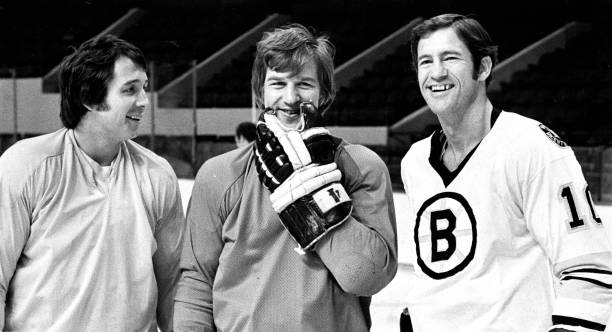
Bobby Orr, faking a forced smile while flanked by new teammates Brad Park, left, and Jean Ratelle in the Bruins’ first practice after the Nov. 7, 1975 blockbuster bringing the two New York Rangers (along with defenseman Joe Zanussi) to Boston in exchange for Phil Esposito and Carol Vadnais.
It’s not just the results.
The Bruins’ 7-7-2 record has them in third place of the Atlantic Division on this off day at the fortunate front end of the National Hockey League’s translucent, 11-team bubble of clubs within one game of “NHL .500” (New York Post writer Larry Brooks’ term, but I endorse it).
As an aside, real .500 is winning half your games, something the Bruins have not done. A playoff trajectory requires two things, winning more than half your games and adding an average number of loser points (overtime/shootout losses). The average should be determined according to the playoff eight within a conference at any given time.
In the salary-cap era (2005-), that is the most-reliable method of determining a team’s true playoff trajectory. The outliers are few and far between. An example would be when the 2015-16 Bruins, in Don Sweeney’s first season as general manager, went 42-31-9 and lost out on the final day to 41-30-11 Detroit, which had the first tiebreaker in regulation/OT wins at 39-38. (Now regulation wins constitute the first tiebreaker, followed by ROW’s.)
I digress.
It’s the eye test.
The Bruins are failing.
Last weekend’s back-to-back shutout victories over Philadelphia and Seattle were encouraging, but neither of those teams is playing well. The Flyers (5-8-2) are in a rebuild, and at 6-8-1 the Kraken (much like the Bruins) have acquired talent and are off to a disjointed start.
What happened on Saturday night at TD Garden has to be of grave concern to Bruins management.
Granted, the visiting Ottawa Senators were a 6-7-0 team looking to win a big one on the road for their goaltender Linus Ullmark. It was a bigger moment in their season than it was for the Bruins vis-a-vis Jeremy Swayman, mainly because Swayman got to stay, Ullmark was traded away to make room for Swayman’s starts (and contract).
Beyond the goalie hug briefly revisited during pregame warmups to the delight of the fans in the Garden early enough to witness it, the two remain linked via their identical $8.25 million-per-season salaries. It’s no accident that Ullmark’s extension (kicks in next season) matches Swayman’s paygrade. The Sens were clearly waiting on that number to ensure Ullmark was treated just as fairly. Canadian dollar vs. Massachusetts’ tax-the-millionaires program, that’s all above my paygrade. It’s symbolic anyway.
But back to the eye test.
The Senators so thoroughly outplayed the Bruins that the home team ran out of gas trying to keep up, and in the third period the wheels came off to the tune of a 12-0 shots-on-goal advantage for Ottawa. The third period was essentially a Sens powerplay.
There is a malaise (Jim Montgomery’s term) around the Bruins this season that reinvents itself in various ways on a consistent basis, undermining what would have been celebrated as tremendous starts to certain careers in Boston such as Mark Kastelic’s. The fourth-line center has recently been kicked up in the lineup because he manages to compete with such ferocity and, at the same time, structure. It’s frankly hard to believe Ottawa was willing to move him to the Bruins.
Far more subtly but of greater intrigue has been the fine play of Elias Lindholm. His seize-and-strip of Rasmus Andersson that gave Brad Marchand his opportunity to score the overtime winner Thursday night against Calgary was one of many examples of his Patrice Bergeron-like ability to sneak up on puck carriers, eliminate them and take the puck away.
Lindholm’s offense has not been fully tapped, but then again, David Pastrnak has been not been as good as his 6-8-14 (16GP) scoring line. Last night, he passed up a beautiful shooting opportunity to misconnect on a pass. It was a 2-on-1 reminiscent of the inexplicable passing up of a similar chance in the third period of Game 5 of the 2023 series against Florida (he shoots, he scores, Bruins win … who knows from there …). It looked just like that one.
Instead, the lack of shot attempts at seemingly opportune moments sent the TD Garden crowd into groans, convulsions and, finally, booing. Of course, we don’t see from upstairs what they see on the ice. We’re not as good as them. Not in our dreams.
That said, there is a lack of confidence that team captain Brad Marchand, after the game, acknowledged in his postgame comments to the media.
But, far beyond that, the Bruins’ were largely unable to get out of their zone last night against the Senators, who launched into the Florida Panthers’ strategy of hard-arounds to lock the Bruins into penalty-kill mode lest they stray from their zone-defense. (The highly successful zone installed by Claude Julien was kept and tweaked by Bruce Cassidy and, in turn, kept and tweaked by Jim Montgomery.)
Paul Maurice should receive royalties like that agency ASCAP every time a radio station plays “Never My Love” by The Association.
In fairness to Montgomery, he has given the Bruins many emerging mini-strategies to cope with D-zone pressure, recover possessions, and layer breakout schemes that were evident even in last night’s game.
Somewhere along the line, it’s up to the players to meet, match or exceed the opponents’ compete level, be stronger on their sticks as Julien used to say, take the territory on the halfwall and say this patch of ice is mine – I dare ya.
It’s not happening.
The Bruins are playing well in spurts, then struggling at 5-on-5 most of the time. Some nights, like last night, they’re getting beaten like a drum.
Swayman misses Ullmark, but the Bruins don’t. Not really. Joonas Korpisalo has been very good, sometimes excellent, in his role. Swayman, who had no training camp with the team, has gotten better as he’s has played into form. The Vezina-winning goaltending that Ullmark gave the Bruins in the first half of their 65-win, 2022-23 campaign would have translated into some undeserved points this season, but neither his nor Swayman’s career body of work would change the state of the Bruins as they are now.
Goaltending, some excellent hockey from the Bruins’ revamped fourth line (Kastelic with Johnny Beecher and newcomer Cole Koepke), the steady two-way presence of Hampus Lindholm on the blue line, the re-emergence of the tenacious and talented Pavel Zacha as a top-six force including shifts back in the center position, and Marchand’s own, athletic progress following a three-surgery summer are key factors keeping the Bruins’ ship afloat.
But, as a team, how can the Bruins, after challenging most of last season for the Presidents Trophy and the Atlantic Division and then winning a playoff series, look so overmatched on so many nights this fall?
Not in the 49 years since Phil Esposito was traded to the Rangers has a Bruins team that, on paper looked like a Stanley Cup contender, so thusly meandered. They were 5-5-2 when Harry Sinden pulled the trigger on the biggest deal in franchise history but, after winning three out of four, lost 4-0 at Buffalo.
Sometimes it’s time.
What time is it now?
Well, if you’re Don Sweeney and you added two significant free agents to the team that was in league and divisional contention last spring and then won a round, plus made the long-awaited goalie move that fortified center depth, added speed and tenacity to the forecheck (along with some highly welcomed roughhouse factor) and most of your returning cast can’t sustain a B game much less an A game, what’s the conversation?
Sweeney told the preseason press gathering that extension talks with Montgomery were underway. Had the team been off to the kind of start it had enjoyed the last two October-November’s, then that announcement would be due any day now.
Imagine the internal tension if the agreement has been reached, yet withheld from public announcement until the Bruins find their 2024-25 mojo. If not, the grossly unfair world of coaching as a results business is knocking on Montgomery’s door.
Something’s gotta give.
A team doesn’t fare as well as the Bruins did last season, add to the lineup to position itself for Cup contention, then break up the band. The player shake-up came in the summer when Ullmark went to Ottawa and free agents Elias Lindholm and Nikita Zadorov signed with the Bruins. That was it.
Meantime, the Bruins take a step forward and a step back, but that’s only the record. The 1975-76 Orr-less Bruins looked woefully overmatched by the 1975 Cup finalist Sabres in that 4-0 straw that broke the camel’s back. That was enough to Sinden to follow through with Rangers counterpart Emile “The Cat” Francis on the blockbuster that redefined both former contenders for the duration of the decade.
The deal worked out immediately for the Bruins, especially in the wake of Orr losing his final season in Boston after only 10 games (the first 10 games that Brad Park, Jean Ratelle and Joe Zanussi played for the Bruins). Ratelle even outperformed Esposito, who (with Carol Vadnais) would eventually find traction in New York, turning the tables on the pre-dynastic Islanders and making the 1979 Cup final. What an event that Stanley Cup series would have been, had the Bruins been able to keep it together in Montreal and keep that appointment.
Slightly off topic, “Keep Your Head Up, Kid: The Don Cherry Story” has been airing on Prime. I can’t believe it took me this long to know about it and watch.
Again, I digress (the privilege of blogging).
The stakes are nowhere near as high today, except for the fact of hockey as big business in the world of professional sports. We’re talking many millions of dollars invested in the Bruins via corporate partnerships. In that sense, OK, this is a big deal, and a ton of thought, conversations, debates, meetings, is going into the decision as to what next.
Sweeney inherited Julien in 2015 upon taking over for Peter Chiarelli, went into a second season (2016-17) with the incumbent, Cup-winning coach but, after the holidays when the Bruins lost their way and were sinking out of the playoff picture, he got his own guy in there (Bruce Cassidy).
Meanwhile, Jay Leach was being groomed in Providence (AHL) but left the Bruins for a NHL opportunity with Seattle. Now he’s back in the Bruins’ organization and on the Boston bench as a new assistant helping Associate Coach Joe Sacco and fellow assistant Chris Kelly. His presence on the Boston bench feels eerily similar to Cassidy’s promotion to assistant in what would become Julien’s final year.
I’ve been asked how many new coaches does a GM get, the implication that Sweeney’s job should be on the line. Fan impatience talking, and it’s coming from many frustrated directions focusing on the lack of a deep playoff run, the likes of which the Bruins only enjoyed during Sweeney’s tenure in 2019.
Even if, then Sweeney has a whole season to right the ship. A GM who’s averaged 51 wins per 82 games since choosing his own coach doesn’t get fired because of an uncharacteristically poor start. And, while we’re at it, the in-house acknowledgment that the Bruins needed to become more of a playoff-style team doesn’t mean they are either planning on or contented with a regular season spent on the playoff bubble.
That is not the plan. Pro sports has a preseason plan and expectation, but in-season life is a day-to-day and week-to-week phenomenon.
And, while we’re at it Part Two: Teams like the 2015-16 Penguins and 2018-19 Blues who fired their coaches to save seasons headed south and then rallied to win the Stanley Cup (the February 2017 Bruce Cassidy promotion and Peter Laviolette’s December 2009 hire in Philadelphia are also examples of drastic in-season impact) cannot become anyone’s strategy.
At the point those teams made the change – and things were darker for those teams than they are for the 2024-25 Bruins, especially so early in the season – it was about survival, changing direction. Those teams were staring at the bottom. Realization of a greater trajectory even exceeding preseason expectations would emerge much later in the process.
The Bruins, comparatively speaking, are in the pack. The only problem is they see themselves as one of the big dogs galloping on the chase but find themselves doing the doggy paddle and watching what they thought they were whizz by them.
In regards to how many fires-and-hires Sweeney gets, he hired Montgomery, but apparently he was not prepared to find a new coach when he met the press three weeks before firing Cassidy, having told the press he planned to bring him back. The belief here is that the decision to make a change came from above his pay grade, and I suspect it had to do with the handling of Jake DeBrusk in particular.
Ironically, the Bruins moved on from DeBrusk, leaving second-rounder Brandon Carlo as the lone pick from the infamous 2015 draft (Sweeney later acquired Zacha, who had gone sixth overall to New Jersey, in a trade for Eric Haula, whom he had signed as a free agent – so there’s that!). As an aside, 2015 Boston pick Jeremy Lauzon (the Kraken’s first pick in the 2021 expansion draft) would have looked good in this Boston lineup at a price that would afford the Bruins cap space for a RW. And, to add a comedic touch, the Minnesota Wild used the 2015 fifth-round pick it got from Boston in an exchange for the Wild’s 2016 fifth-rounder to draft … drum roll please … Kirill Kaprizov. The next year, the Bruins used Minnesota’s fifth-round pick on 2016 NAHL Defenseman of the Year Cameron Clarke, who played four years at Ferris State but as a professional never made it past the ECHL.
Where oh where does that leave us this morning?
At 7-7-2, it’s very easy to look at the Boston Bruins on paper, say it’s early, call this roster a Cup contender, and at least give it until Thanksgiving, the celebrated benchmark of the NHL playoff race, before considering anything drastic.
Then there are efforts like last night’s, and the scariest aspect of it is the Bruins didn’t look like they weren’t trying or didn’t care. That’s not the problem. I think I’ve only heard Montgomery mention “passengers” one or two times this season. It may be mental, and it may be coincidental that so many returning players in the top half of the lineup hit the ground in snow shoes. But, even with some of those same players showing tangible signs of progress and looking better at their game, the team as a whole continues to look overmatched against ordinary opponents.
From a results standpoint, a poor powerplay and especially an uncharacteristically poor penalty kill are going to tarnish any team’s record. But this is not about 7-7-2 – nobody starts every season 14-1-3 (2023-24) – this is about what the Boston Bruins look like playing the game.
It’s not good.
Management expected much more.
The coach’s contract extension has not been announced.
The roster makeover occurred over the summer.
The Bruins were outshot, 12-0, last night on home ice in the third period of a game they led into the third.
Marchand continues to face the media and patiently answer questions, making sure his A-wearing alternates do likewise.
Thanksgiving is less than three weeks away.
Tick, tick, tick …
 Rink Rap with Mick Colageo