It’s completely understandable how coaches and players size up results, especially losses that end seasons. A bounce here, a break there, a penalty here, a post there.
They’re in the heat of battle, the thick of the competition, never too high, never too low, always mindful that it’s not over until it’s over. It’s no wonder that the eyes of amateur scouts are as trained on compete level, intelligence and intensity as they are on any physical attribute or skill.
In the early 1990s, Petr Korda, the Czech-born father of golf superstar Nelly Korda, was a bright new star on the ATP circuit. After winning an opening-round tennis match in New Haven, Conn. (then a featured lead-up to the US Open), sportswriters asked him when he knew he had the match won.
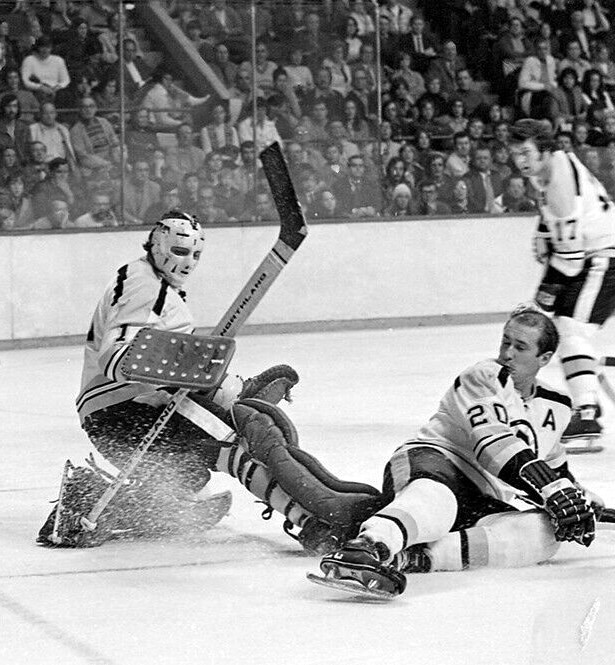
Perhaps the most underrated No. 1 in Bruins history is Eddie Johnston, seen here in a close call with defenseman Dallas Smith and Fred Stanfield. Johnston’s role in the 1972 Stanley Cup run splitting the nets with Gerry Cheevers was superior, especially considering the Bruins averaged 4 goals against in their shocking, 7-game upset loss to Montreal in 1971. In ’72, EJ posted a 6-1 record with a 1.86 GAA and .936 save pct. Cheevers, though he shut out the Rangers in the clincher, was not quite as tight at 6-2, 2.61 GAA, .915 SP. But Cheevers does hold the greatest modern-era playoff performance, going 6-3 with a 1.68 GAA and a .947 SP. It took a Jean Beliveau snipe in double overtime of Game 6 to end the dream.
“After the last point,” Korda said with a straight face. The answer drew some chuckles, after which Korda explained how serious he was. “You have to win the last point,” I recall him saying.
The media wasn’t buying, but they also weren’t professional athletes.
My other takeaway from Petr Korda that day: “Anything with ball, I am good.”
Evidently so are his kids, but had Korda thought like the media, it’s very unlikely he would ever have won a major (1998 Australian Open) or with fellow retired tennis pro Regina Rajchrtova raised two LPGA champions including a World No. 1 (Nelly) and a tennis-playing son (Sebastian) who in August achieved a top-15 world ranking. Before stepping away from golf to raise a family, older sister Jessica Korda reached No. 13 on the LPGA Tour.
Every serve, every return, every fairway, every putt, players have to be in the moment. Never far away, their coaches tend to follow suit.
General managers, on the other hand, must always remember how their teams win or lose. Where was the ceiling on their team? Were they destined to fall short like the 2018-19 Bruins or were they more like the 1988 and ’90 Bruins, on a collision course with a dynasty?
So how high is the ceiling on the 2024-25 Boston Bruins?
The belief here is that the July 1 signings of free agents Elias Lindholm and Nikita Zadorov remove the ceiling off these Bruins, who henceforth belong in the Cup conversation. Signing Jeremy Swayman would obviously encourage such lofty musings, but with just solid goaltending the next-gen Bruins are coming to fruition. Assuming Joonas Korpisalo can recover the form he displayed two seasons ago with Los Angeles, winning is not out of the question.
Flashback to June 15, 2011:
’Twas a chaotic night in Vancouver, the shuttle buses from the arena having been shut down one hour after the game, even as the Bruins continued engaging reporters.
Less than two blocks away, a wall of riot police pointed a trio of sportswriters two blocks northeast before we should turn uphill in the direction of our hotel a dozen blocks away. Laptops slung over our shoulders, three times we broke into a jog to skirt the anarchy pouring out of abutting streets.
We passed a young man in a white Bruins sweater who was ignoring the pleas of his girlfriend not to meander toward the noise, then a destitute mother pushing a baby carriage, seemingly oblivious to the potential harm.
Probably a half hour before we began our adventure on Vancouver’s streets, I found Claude Julien at the far end of Rogers Arena ice. The Bruins had already marched the Cup into their champagne-drenched, dressing room but then returned in full gear to accommodate those of us stuck farther back in the media queue that lapped around the arena’s underbelly.
Having just finished an interview with a small TV crew, Julien was gazing at the nearly empty stands when I approached to offer my congratulations. Moments alone with the coach were not easy to come by amidst the Bruins’ long-awaited return to popularity in a market demanding (then fawning over) only winners, so this circumstance was a welcome surprise.
“Mick, did you think we were a championship team?”
Claude grinned ear to ear awaiting my response. Arrested by the occasion as much as the question, I hesitated (I had Canucks in six). “What, no words?” Claude doubled down, mimicking the NHL promo featuring a variety of teary-eyed winners overwhelmed at the sight of the Stanley Cup.
“I knew you could be (champions),” was my feeble reply.
Final Step
The summer before, GM Peter Chiarelli removed that team’s ceiling when he dealt defenseman Dennis Wideman to Florida in the multi-player trade that brought forward Nathan Horton to Boston. Triumphantly, I wrote in The Standard-Times (New Bedford, Mass.) that the Bruins were henceforth eligible for the prize.
I had long held that to win the Cup a team requires a defenseman who can improvise the breakout. Trading a talented player like Wideman was antithetical to the theory, but I was equally convinced that he was not quite cut out for the sport’s most-demanding role.
Puck-moving defenseman sounds fun, but the job comes with an uncompromising set of standards. A top-pairing PMD cannot lean on that special ability, cannot abandon structure, cannot cheat the game, cannot wilt under pressure, cannot miss an assignment, cannot play soft, cannot lose intensity, etc. Moreover, to win a PMD must be a superior skater, a tough customer, and be obsessed with his craft. Otherwise, he’ll rack up points and All-Star votes, maybe even Norris votes, but he won’t win.
Fulfill all those requirements, endure some hard knocks over at least four NHL seasons, and said player over age 22 might earn a sip from the trophy.
Wideman wasn’t there to complete the journey in 2011, and ironically neither was Horton. The Bruins were down two games when Aaron Rome’s late hit early in Game 3 knocked the top-line right winger unconscious and out of the Cup final.
Given the series deficit and the significance of the injury, in the moment it seems the Cup final easily could have devolved from competitive grind to a potential sweep. But it had the opposite effect.
“Don’t. Poke. The. Bear.” – Jack Edwards
A fired-up Zdeno Chara visited the visiting bench to instruct the players sitting on it that they would not make it through the series. The spinal injury that Mason Raymond would sustain in Game 6 while backing into the Zamboni corner in a clinch with Johnny Boychuk was quirky, awkward and disconnected from the hockey would unfold over the final five games of the series.
What mattered was that the Bruins were not looking to the league or to the officials for justice. They were going to settle this themselves. Compromised by the loss of a key player, every Bruin got more than that much better the moment the gurney carrying Horton left the ice.
The next time Horton would touch ice, it was secretly collecting snow left behind by TD Garden’s ice makers that he famously stuffed into a plastic container. The slush that melted magically reappeared before Game 7 when Horton poured it out onto Rogers Arena’s rink. Up until then, both teams had won all three home games, and from the sidelines Horton found a way to inspire belief before the decider on enemy ice.
Digging deep
The adjustments to Horton’s injury were far reaching.
Summoned from the third line, Rich Peverley left season-long linemates Chris Kelly and Michael Ryder to skate with David Krejci and Milan Lucic. Tyler Seguin moved into Peverley’s spot, and Shawn Thornton reassumed his regular role alongside Gregory Campbell and Dan Paille.
Ironically, Patrice Bergeron, Julien’s longtime last card when it came to line combinations, stayed between respective career bookends Brad Marchand (age 23) and Mark Recchi (43). Theirs was the only line unaffected by the Horton injury.
Over three prior campaigns, Julien had turned Wideman from a project into a player. The talented defenseman could thread a needle with a pass from 120 feet away, but he could also saucer one at his own bench during a line change. … “Boston bench minor, too many men …”
Fleeting intensity and so-so speed presented an enigma that by 2010 the Bruins were ready to cash in for the equally enigmatic Horton, by contrast a beautiful, powerful skater who could have played Mike Modano in a movie but had never shown he could play like Modano did when the Stars reached the pinnacle in 1999.
Horton nonetheless seemed like a perfect fit to complete the top line. He had the power that Krejci didn’t and the grace that Milan Lucic didn’t.
Winning the Cup was still too much to ask, especially without a defenseman sufficiently skilled to navigate the storm of a playoff forecheck.
Bench boss
This is probably where Julien’s legacy in Boston sports is most underappreciated.
For two-thirds of every game, Bergeron and Krejci were the Bruins’ PMD’s. They went all the way back to inject glue into the breakout.
What wasn’t always available in the system or when trading bounce passes off the backboards failed to discourage opponents’ puck pursuit, Bergeron and Krejci used their skills, their vision and their hands to add layers of imagination and improvised to mitigate the absence of the player Chiarelli had hoped Wideman would become.
As an aside, deadline pickup Tomas Kaberle made an uninspiring first impression but in a limited role added some much-needed skill to the third pairing.
At the end of the day, though, the Bruins won without an elite PMD because Julien recognized what he had at the center position and used it to concoct a formula that, while capping Bergeron’s and Krejci’s offense (by asking them for 200 feet of elite defensive and transitional play), maximized their impact.
Krejci would still lead the 2011 playoffs in scoring, repeating the feat in 2013.
Coach Ken Hitchcock’s role in the 1999 Western Conference Final for Modano, arguably the greatest American-born player of his generation, was to check Peter Forsberg.
For his part, the Colorado superstar didn’t exactly crack. His series was not given to retaliation calls, and he not only outscored Modano over the seven games (2-5-7 to 1-4-5) but finished the series plus-2 (minus-2 in Game 7) to Modano’s minus-3.
The point is, to win the Cup, a point-per-game center just shy of age 29 and on track to finish his NHL career with 561-813-1,374 regular-season totals and 58-87-245 for the playoffs was asked to take on a defensive role and accepted it.
Coaches do what they do to win, not to entertain nor to soothe egos.
Had Julien been half as stubborn and overly defensive as widely advertised, why would Krejci and Marc Savard and their silky mitts be centering his top six?
When Julien came to Boston, the Bruins needed structure, they needed to develop a culture of being strong on their skates and strong on their sticks, and the culture had to run through the most skilled players on the team, even Phil Kessel and Tyler Seguin in their closely separated tenures.
That Julien could find his answers without disturbing Bergeron’s line and do so with his team trailing the Cup Final 2-0 was a sign of the team’s overall maturation, a process that began in earnest in the fall of 2007.
Monty making adjustments
Jim Montgomery won’t ever ask of Trent Frederic and Morgan Geekie what every one of Bergeron’s coaches asked of him, but they will be staying warm in the bullpen for a variety of solutions to whatever else isn’t working in camp.
“The short answer to that is yes,” Montgomery confirmed on Wednesday, implying that any delay in consistent linemates for Frederic or Geekie is not indicative of a lack of belief in either player. In fact, Montgomery indicated quite the opposite to be true.
Superior marks
Since promoting Bruce Cassidy as his chosen coach (he inherited Julien), Sweeney’s teams have won 357 of 563 regular-season games; that’s two more than the 2001 Stanley Cup Champion Tampa Bay Lightning won over the same stretch (both teams played 70 games in the real 2019-20 season).
However, both the Lightning and the Bruins lost in the opening round of their record-challenging seasons, Tampa winning 62 games in 2019 but hitting the wall against a hard-checking Columbus team and getting swept, opening the door for the Bruins to bounce back from a 2-1, second-round deficit to beat the Blue Jackets in six and carry that momentum to a sweep of Carolina in the Eastern Conference Final.
Made to wait 11 days to play St. Louis, the Bruins went 1-3 at home in the fateful final, winning only the feeler-outer Game 1 and ultimately showing their fatal flaws in Game 7.
Those Bruins had several championship components left over from 2010-13, from their veteran core of forwards including Bergeron, Krejci and Marchand and in goal Tuukka Rask. The rest of Sweeney’s team hadn’t quite settled itself out.
Chara was 42, McAvoy 21. No team has ever won the Cup with a top-pairing defenseman that old or that young; the Bruins had both, a challenge exacerbated when Chara sustained a broken jaw during the final series.
The key piece that Sweeney traded this offseason (Linus Ullmark) only leaves as noticeable a hole as Wideman’s because Swayman and the Bruins have yet to reach a contract agreement. That situation and the Korpisalo acquisition “don’t run in the same lanes,” said Sweeney. Korpisalo was coming to Boston regardless.
Sweeney is most publicly mindful of the fact the Bruins have only one post-Bergeron/Krejci season under their belts. The expectations are high for Elias Lindholm, who will join Coyle, strengthening the Bruins down the middle of the rink.
Despite Mason Lohrei’s breakout 2023-24 postseason, Sweeney has also brought in 6-foot-6, 248-pound Nikita Zadorov, an addition that should ease the game for McAvoy.
Sweeney continues to downplay other size he has signed for the forward lines, including Mark Kastelic (6-3, 210) and Max Jones (6-3, 216), a common denominator running through his offseason acquisitions that he insists is coincidental.
Sweeney wants a more aggressive forecheck. He is painfully aware that the Bruins on his watch have not given as much as they get at each end of the ice, but speed is the only uncompromising aspect to which he points. The size aspect he has shrugged off on multiple occasions since July 1.
Tall expectations
Based on ages on Dec. 31, this Bruins roster is at the ideal age to pursue the Stanley Cup.
At 36, Marchand is an outlier, and in his case mileage is a more formidable threat than age. The next oldest player is Charlie Coyle, who turns 33 in March 2025.
The average on a predictable 23-man roster will be 26.869 years old, and the mean dominates the equation. Not a lot of age, not a lot of youth. By and large, the 2024-25 Bruins are in a nearly ideal position of athletic primes couched in career maturity. They are old enough to know how to play and young enough to compete.
Sunday’s 5 p.m. preseason opener against the New York Rangers at TD Garden (NESN, 98.5 The Sports Hub) won’t count in the standings, but individuals with something on the line are generally aggressive so, especially if Peter Laviolette dresses Matt Rempe, this will be a trial run for a more physical Boston team.
Follow on X @MickColageo
 Rink Rap with Mick Colageo
Wow, that was a fantastic read!
LikeLiked by 1 person