The purpose of the following exercise is to chart basic outcomes during the NHL’s salary-cap era (2005-06 …) and, farther down, identify two team-building identification points common to teams that win the Stanley Cup.
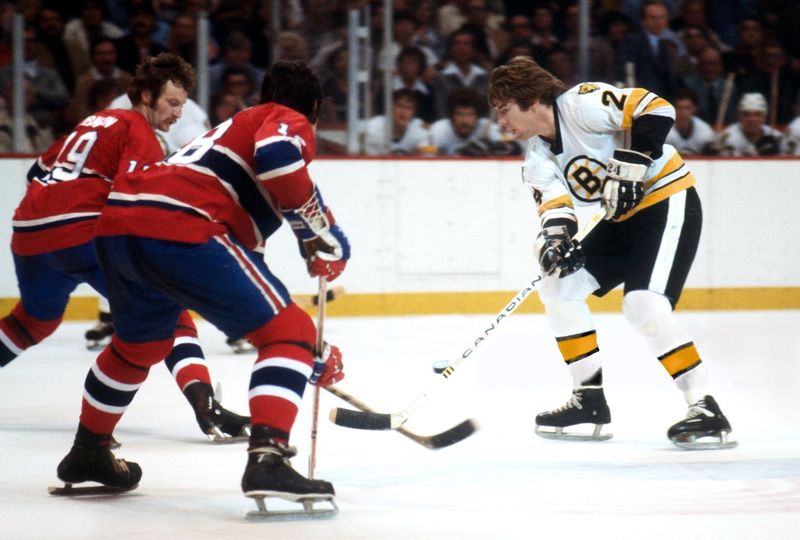
Two-thirds of Montreal’s vaunted Big 3 of the late 1970s, Larry Robinson and Serge Savard, put up a wall in front of Terry O’Reilly.
Three general points:
- The Presidents Trophy is not a curse, as one of the top regular-season teams must win it, and a check of Cup champions shows that the Cup winner usually comes from that upper crust of regular-season teams.
- There are no fluke champions. Teams build up to Cup contention, and the evidence is in the fact that, with few exceptions that can be easily explained, every Cup champion of the salary-cap era has gone to another Cup final within four seasons of that triumph, invalidating the NHL-promoted notion that the season is a roulette wheel in which anything can happen (that’s good for sales, but it’s not reality as proven by history).
- There are two foundational roster models for Cup contention: two elite and/or high-performing centermen or a big-three defense.
THE PRESIDENTS TROPHY MYTH
Below is a list of salary-cap-era Stanley Cup champions and Presidents Trophy winners, including where the Cup champion finished in the conference and overall and how far the first-overall finisher went in the playoffs. Note: The 2019-20 season is not included because the playoffs were held a full offseason after the regular season and were rendered void of typical continuation factors including injuries.
Season: Cup Champ > RS Finish Prez Trophy > Round (lost to > how far that team went)
Guide-left: E, W mean Eastern, Western Conference / T4 means tied for 4th overall.
Guide-right: R1 means lost in the first round of the playoffs.
2005-06: Carolina > 2E / T4 Detroit > R1 (Edm > final)
2006-07: Anaheim > 2W / T3 Detroit > WCF (Anaheim > Cup)
2007-08: Detroit > 1W / 1 * Detroit > Cup
2008-09: Pittsburgh > 4E / 8 San Jose > R1 (Anaheim > R2)
2009-10: Chicago > 2W / 3 Washington > R1 (Montreal > ECF)
2010-11: Boston > 3E / 6 Vancouver > (final)
2011-12: Los Angeles > 8W / 13 Vancouver > R1 (Los Angeles > Cup)
2013: Chicago > 1W / 1 * Chicago > Cup
2013-14: Los Angeles > 5W / T8 Boston > R2 (Montreal > ECF)
2014-15: Chicago > 4W / 7 NY Rangers > ECF (Tampa Bay > final)
2015-16: Pittsburgh > 2E / 4 Washington > R2 (Pittsburgh > Cup)
2016-17: Pittsburgh > 2E / 2 Washington > R2 (Pittsburgh > Cup)
2017-18: Washington > 3E / 6 Nashville > R2 (Winnipeg > WCF)
2018-19: St. Louis > 5W / 11 Tampa Bay > R1 (Columbus > R2)
2021: Tampa Bay > 3Central / T8 Colorado > R2 (VGK > SF)
2021-22: Colorado > 1W / 2 Florida > R2 (Tampa Bay > final)
2022-23: Vegas > 1W / T4 Boston > R1 (Florida > final)
COMMENTS
While the 2007-08 Red Wings and 2013 Blackhawks are the only cap-era Presidents Trophy winners to go on to win the Stanley Cup, there are two sets of cap-era data to look at when discussing the merits of a Presidents Trophy season.
First, the obvious data widely used to discredit regular-season pursuits (beyond making the playoffs). The suggestion that the Presidents Trophy is a negative, even curse, overlooks the fact that there are usually three or four teams engaged in the pursuit for regular-season excellence. The real evidence of this folly is in the fact that, in 17 seasons of cap-era hockey (not including the disconnected 2019-20 season), more than half (9) of the Stanley Cup champions had one of the two-best records in their conference.
Myth: All you’ve got to do is get in, and anything can happen.
It may feel that way even to (perhaps especially) the competitors themselves, but what is the legacy of the 2009-10 Philadelphia Flyers? Yes, they needed a shootout win against the N.Y. Rangers on the final day of the season to make the playoffs; then they proceeded to rally from an 0-3 series deficit to eliminate the Bruins and went all the way to Game 6 overtime before Patrick Kane’s amazing move to shake Kimmo Timonen at the left half wall and sneak that puck past Cinderella goalie Michael Leighton in one of the sport’s most chaotic moments ever.
A: The slipper fell off the Flyers. B: Even for the proven, there is often drama en route to the championship. Even the dynastic Islanders needed an overtime goal in a deciding Game 5 to escape Pittsburgh’s opening-round upset bid in 1982. That doesn’t mean the 31-36-13 Penguins were anywhere near the Cup that the Islanders had already won twice and would win twice more in succession.
Appealing to the 2011-12 LA Kings (eighth in the West that season and then they ran roughshod through playoff competition) and to a lesser extent the 2018-19 Blues (who had been last overall in January 2019 before rallying to a fifth seed in the West), these out-of-nowhere scenarios are as rare as the Presidents Trophy/Stanley Cup parlay.
The NHL enjoys, even promotes, the illusion that the playoffs are some sort of roulette wheel, a 16-team mosh pit without rhyme or reason.
The message here is, yes, embrace the chaos, ride the adrenalin rush of the opening round and enjoy watching teams that thought they were in the hunt crash and burn.
But don’t buy the hype.
In a 32-team league with a salary cap, there is still a team-building process that reveals itself in the winner’s circle.
A top-four, conference finisher has won the Stanley Cup all but three times in the salary-cap era (which is now almost two decades old), and two of those three exceptions were fifth seeds. One of those fifth seeds was LA, which though tied for eighth overall in the NHL in 2013-14, was a 100-point team, almost the same team that won from the eighth spot two years earlier. So even in the case of the wildest Cinderella playoff story of the era, the Kings proved to be no Cinderella at all, winning the Stanley Cup twice in three years and making the conference final the year in between. They were the Western Conference version of the Bruins, who made two Cup finals in three years and won a Presidents Trophy in the same era.
Another fact to consider when picking a darkhorse Cup champion: Only three times in the salary-cap era has a team on less than a 100-point pace (per 82 games) won the Cup: the 95-point Kings of 2012, the 99-point Penguins of 2009 and the 99-point Blues of 2019. ALL THREE of those teams made in-season coaching changes.
Has yours?
If not, and your team did not put up 100 points in the standings, you’re trying to break new ground.
Just sayin.
Here is what it really comes down to: With rare exception, Stanley Cup champions have proven their legitimacy and validated their championship run with another appearance in the Cup final within three seasons of their title run.
Season Champ other Final appearance
2006: Carolina 2002
2007: Anaheim 2003
2008: Detroit 2009
2009: Pittsburgh 2008
2010: Chicago 2013
2011: Boston 2013
2012: Los Angeles 2014
2013: Chicago 2010/15
2014: Los Angeles 2012
2015: Chicago 2013
2016: Pittsburgh 2017
2017: Pittsburgh 2016
2018: * Washington
2019: * St. Louis
2021: Tampa Bay 2022
2022: Colorado on the clock
2023: Vegas 2018
The only two Cup champions to fail in this regard are the 2017-18 Capitals and the 2018-19 Blues.
What can be said about Washington: To me, the fact they lost in six to the Penguins in both the 2016 and 2017 playoffs and won the Presidents Trophy both of those seasons is a practical facsimile to making another Cup final.
What can be said about St. Louis: The Blues’ roster was foundationally based on a Big 3 defense (more on this below) of Alec Pietrangelo, Colton Parayko and Jay Bouwmeester. In the management blunder of the decade, the Blues let Pietrangelo walk as a free agent at the time that an already aging Bouwmeester was forced into retirement by a cardiac condition. Suddenly, two-thirds of their foundation was gone, but they doubled down on the losses by changing the foundational makeup of their defense, accenting skill over length and underestimated Pietrangelo’s impact and watched him help Vegas win the Cup last year. By the time GM Doug Armstrong began acquiring players to restore some of the size lost, it was far too little and too late. There is no way a St. Louis team without Pietrangelo and a valid Bouwmeester replacement was going back to the Cup final anytime soon.
TWO CHAMPIONSHIP MODELS
Not every team needs a Big 3 D to contend for the Stanley Cup. There is another way (presuming that the defensive structure is as sturdy and sound as it is skilled), and that is via two elite centermen, bonafide No. 1s who could functionally admirably in that top-line role on most any team.
Built around Sidney Crosby and Evgeni Malkin, the three-time (cap-era) champion Pittsburgh Penguins provide the best example of a team with two, top-line centers retooling in the spirit of the Western Conference champions of the 1990s (Detroit with Steve Yzerman and Sergei Federov, Colorado with Joe Sakic and Peter Forsberg) and Dallas with Mike Modano and Joe Niewendyk).
Chicago, built around its Big 3 D of Duncan Keith, Niklas Hjarlmarsson and Brent Seabrook, echoes back to the New Jersey Devils of Scotts Stevens and Niedermayer and either Ken Daneyko (1995) or Brian Rafalski (2000, 2003) and ultimately to the Montreal Canadiens who provided this blueprint with Larry Robinson, Guy Lapointe and Serge Savard (prior to Robinson’s 1973 integration, Jacques Laperierre was the third member, especially once J.C. Tremblay went to the World Hockey Association). But it wasn’t until the Canadiens were rattling off four straight championships in the second half of the 1970s that the Big 3 moniker became shop talk for team building. (Only a few years later, the Boston Celtics would make Big 3 a part of NBA team building with Robert Parish, Kevin McHale and Larry Bird.)
To contend for the Stanley Cup, it takes a village. This includes clutch (if not historically great) goaltending, many intangibles including harmony off the ice, a great coaching performance, luck with injuries, perhaps even the tournament draw.
What we’re isolating above is the historical evidence that championship hockey teams tend to exhibit one of two elite roster qualities and have definitely done so throughout the NHL’s 1967- expansion era and onward through the salary-cap era that dates back to the 2005-06 season.
TWO NO. 1 CENTERS
Season Champ Top-Two Centermen
2006: Carolina Eric Staal and Rod Brind’Amour
2009’16’17: Pitt Sidney Crosby and Evgeni Malkin
2011: Boston David Krejci and Patrice Bergeron
2012’14: LA Anze Kopitar and Jeff Carter
2018: Washington Niklas Backstrom and Evgeni Kuznetsov
2022: Colorado Nate MacKinnon, Nasem Kadri
BIG 3 ON D
Season Champ Top-Three Defensemen
2007: Anaheim Chris Pronger, Scott Niedermayer, Francois Beauchemin
2008: Detroit Nick Lidstrom, Niklas Kronwall, Brian Rafalski
2010’13’15: Chi Duncan Keith, Niklas Hjarlmarsson, Brent Seabrook
2019: * St. Louis Alec Pietrangelo, Colton Parayko, Jay Bouwmeester
2021: Tampa Bay Victor Hedman, Mikhail Sergachev, Ryan McDonagh
2023: Vegas Alex Pietrangelo, Shea Theodore, Alec Martinez
Which brings us to the 2024 playoffs …
THE FINAL EIGHT
(Which model do they aspire to?)
NYR: Big 3 D > Adam Fox, Jacob Trouba, K’Andre Miller
Carolina: Big 3 D > Jaccob Slavin, Brett Pesce, Brent Burns
Florida: 2 centers > Sasha Barkov & Sam Bennett
Boston: Big 3 D > Charlie McAvoy, Hampus Lindholm, Brandon Carlo
Vancouver: 2 centers > J.T. Miller & Elias Pettersson
Edmonton: 2 centers > Connor McDavid & Leon Draisaitl
Dallas: Big 3 D > Miro Heiskanen, Esa Lindell, Jacob Harley
Colorado: (incomplete) … Big 3 D > Cale Makar, Devon Toews, (Sam Girard?)
What decides whether the foundational team-building model will eventually win depends on the quality of the pillars but even more so on how the team is built around those players.
 Rink Rap with Mick Colageo
One thought on “Building A Winner”